The back-to-school season is here, making it the perfect time to reset and get organized. This issue of CUP offers guidance to help you stay prepared for the year ahead, covering candidate speeches and events, dysfunctional boards, DBPR education requirements, and the impact of nearby construction. We also celebrate the 46 Becker attorneys recognized in the 2027 edition of The Best Lawyers in America®. Don’t miss the latest installment of the Latin Corner, which addresses the difference between being a landlord and a resident.
Florida House Bill 797 (2026) introduces several governance reforms aimed at strengthening accountability within nonprofit corporations, including community associations. Bryony G. Swift highlights key changes, including new standards of conduct for officers, judicial procedures for removing directors, and updates affecting registered agents and corporate filings, in “HB 797 Revises and Renames Chapter 617 of the Florida Statutes with a Focus on Transparency.”
Board members may eventually need to decide whether an association should sue a contractor, vendor, or owner. Before weighing the merits of a claim, however, the board should first confirm that the association is still legally permitted to file suit. S. David Cooper explains why timing is critical when preserving an association’s right to sue in, “Tick Tock: Your Associations’ Right To Sue Has An Expiration Date.”
Mary Hawk explains what community associations should know before making alterations to common elements. She breaks down what might be considered a material alteration under Florida law, the voting requirements that may apply, and why governing documents play an important role in, “Things That Are Material Alterations That Might Surprise You.”
THIS CASE examines the proper measure of damages when a contractor builds a residence in a manner that differs from the parties’ agreement. Joseph Markovich underscores the importance of involving qualified legal counsel to evaluate the governing contract, project records, and other evidence needed to support the appropriate damages claim in “THIS CASE: Grossman Holdings Ltd. v. Hourihan.”
Attention CAMS – license renewal deadline September 30, 2026!
Are you shy on credits?
Don’t wait! With the September 30th license renewal deadline fast approaching, the time is now to fulfill your credit requirements. To help you meet the deadline, we are offering a nine class on-demand package including the following courses:
- Record Keeping for Associations (EH1)
- Litigation Landscapes: Enforcement Actions and 3rd Party Disputes (EH1)
- Online Voting, Websites, and Other Tech for Associations (EH1)
- Rewriting Your Governing Documents from Start to Finish (EH2)
- Road Rules: EVs, Parking, and Vehicle Restrictions for Associations (EH2)
- Understanding Florida’s Community Association Education Requirements (EH2)
- Collection and Foreclosure Strategies for Community Associations (IFM)
- How to Properly Run an Election (HR)
- Top 10 Manager Do’s and Don’ts (HR)
- PLUS, a BONUS 10th class: Hoarding and Other Mental Health Conditions (OPP)
Stay tuned for more information!
Articles

HB 797 Revises and Renames Chapter 617 of the Florida Statutes with a Focus on Transparency
By: Bryony G. Swift
Florida House Bill 797 (2026) introduces several governance reforms designed to increase accountability within nonprofit corporations, including community associations. Among the most noteworthy changes are the creation of new officer standards of conduct, judicial removal procedures for directors, and modifications affecting registered agents and corporate filings.

Tick Tock: Your Associations’ Right to Sue Has an Expiration Date
By: S. David Cooper
As a board member, there may come a time when the Association has to decide whether to sue a contractor, a vendor, or even an owner. Before weighing the strengths of the claim, the Board should first answer a simpler question: is the Association still legally allowed to sue? That question catches many boards off guard because Florida law does not use a single deadline. Several different legal doctrines can quietly cut off a claim, and being unaware of these deadlines can cost the Association a case it otherwise would have won.
Things That Are Material Alterations That Might Surprise You
By: Mary R. Hawk
In this video, Mary Hawk explains what community associations should know before making alterations to common elements. She breaks down what might be considered a material alteration under Florida law, the voting requirements that may apply, and why governing documents play an important role. Mary also shares surprising examples of changes that courts have found to be material alterations, from repainting hallway walls and changing outdoor furniture cushions to adding a pool heater. Watch the full video to learn when a project may require unit owner approval before moving forward.
Grossman Holdings Ltd. v. Hourihan, 414 So.2d 1037 (Fla. 1982)
By: Joseph Markovich
The proper measure of damages when a contractor constructs a residence contrary to the parties’ agreement is the issue addressed by THIS CASE. The purchasers contracted with a developer for a home to be built substantially in accordance with the model and plans displayed at the developer’s office. Those materials showed a home with a southeast exposure. After the purchasers entered the contract, the developer displayed a revised drawing that reversed the home’s orientation. Although the purchasers objected before construction began, the developer built the mirror-image home.
The trial court found that the developer had breached the contract but declined to award damages, reasoning that reconstruction would be economically wasteful and that the home had increased in value. The Third District Court of Appeal agreed that a breach occurred but concluded that the purchasers could recover the amount required to reconstruct the home to conform to the plans and specifications. The Florida Supreme Court disagreed with that measure of damages and adopted subsection 346(1)(a) of the Restatement (First) of Contracts (1932) as the law in Florida regarding damages for breaching a construction contract.
Under that framework, the ordinary measure of damages for defective or unfinished construction is the reasonable cost of completion or correction in accordance with the contract, provided correction is possible and does not cause unreasonable economic waste. If correction would require unreasonable economic waste, however, the proper measure is the difference between the value of the construction promised and the value of the work actually received. The Court rejected the distinction drawn by the Third District between homes and commercial buildings: the economic-waste analysis can apply to residential construction as well as nonresidential construction.
While THIS CASE involved a lawsuit by a property owner against a contractor for nonconforming residential construction, subsequent decisions have applied its holding to construction defect claims with varying results. The applicable measure of damages may depend on several factors, including the contract requirements, the nature and extent of the nonconforming work, the appropriate valuation date, the reasonable cost of correction, and, where reconstruction may constitute unreasonable economic waste, the resulting diminution in value. Early involvement of qualified legal counsel can assist in evaluating the governing contract, project records, and other evidence necessary to support the appropriate measure of damages.
No Confunda ‘Ser Propietario’ Con ‘Ser Residente’

Por: Marty Platts
Cuando alguien es propietario de algo, significa que tiene el titulo legal para ese artículo del cual dice ser propietario. El ejemplo más fácil para comprender este concepto es el siguiente: Ser propietario de bienes raíces (casas, hogares móviles, condominios, etc.) donde el propietario tiene el título de la propiedad. El derecho de ocupar una propiedad es independiente al derecho de ser propietario, ya que alguien que no sea el propietario pudiera ocupar la propiedad. Por ejemplo, el propietario puede permitir que un invitado o inquilino ocupe la propiedad.
Question of the Month

Q: Some owners in my condominium association have discussed having candidates running for a local office come speak to our members. However, the board of directors has questioned whether this is appropriate. Is it permissible to invite candidates for a political office to come speak to the members of our condominium association?
Becker Recognized Among the Nation’s Top 20 Construction Law Firms by Construction Executive

Becker is proud to announce that its nationally recognized Construction Law & Litigation Practice has been ranked No. 19 on Construction Executive magazine’s 2026 list of The Top 50 Construction Law Firms. The annual ranking recognizes law firms across the country that demonstrate exceptional strength and commitment to serving the construction industry.
Community association boards and managers should ensure that their communities have adequate disaster planning measures in place as hurricane season approaches. To help you in weathering the storm, check out Becker’s Hurricane Guide which provides important tips and information to help protect your community.
For more information, contact your Becker attorney.
Dysfunctional Boards: The Hidden Cost to Community Associations

FCAP Managers Report
By: Jonathan R. Zim
The greatest challenges facing community associations are not just aging infrastructure, reserve funding, rising costs, or difficult owners. Very often, a significant obstacle to a successful community is a dysfunctional board.
Most directors volunteer because they care about their community. They want to protect property values, improve quality of life, and contribute positively to the place they call home. Yet disagreements can become personal, factions can form, and productive debate can devolve into conflict. When that happens, the effects extend far beyond the boardroom.
Announcing Becker’s On-Demand Class Library

The Florida law mandates that board members of HOAs, Condominiums, and Co-ops take continuing education classes annually.*
Please see our on-demand class library for an extensive list of DBPR approved classes.

Managers and board members of non-clients are welcome to take our courses for $50, unless otherwise specified. Courses are always free for board members of firm clients.
*Breakdown of class requirements for board members and managers of HOA’s, Condominiums, and Co-ops: New Florida Educational Requirements for Board Members and Managers – Frequently Asked Questions
Frequently Asked Questions regarding Becker classes: Becker Classes FAQs
DBPR Education Requirements Made Simple!
The Florida legislature has mandated that board members of a Florida condominium or homeowners association have specific educational requirements. This class allow you to learn what is expected of you each year in your new role, which classes you need to take, which you may want to take, and what classes your managers should take. This class will also let you know about deadlines and repercussions for not meeting the deadlines.
Can They Do That?

Becker’s “Can They Do That” video series tackles some of the unique problems that homeowners and renters face today. We answer your questions, no matter how far-fetched they may seem. From service animals to nudists in your community, we get to the bottom of it and let you know – “Can They Do That?”
Legal Update: House Bill 797—Modernizing Chapter 617 of the Florida Statutes

Florida Community Association Journal
By: Bryony G. Swift
On Thursday, June 25, 2026, the governor signed House Bill 797 (HB 797) completely overhauling Chapter 617 of the Florida Statutes, formerly known as the Florida Not For Profit Corporation Act. Chapter 617 became the Florida Nonprofit Corporation Act on July 1, 2026. Many of the statutory changes in this bill impact Florida condominium associations, cooperative associations, and homeowners’ associations. Note that most community associations in Florida are Chapter 617 corporations, but not every provision within Chapter 617 applies to every community association. Herein I address a few key changes.
Becker Steps Up to the Mic with Podcast,
‘Take It To The Board with Donna DiMaggio Berger’

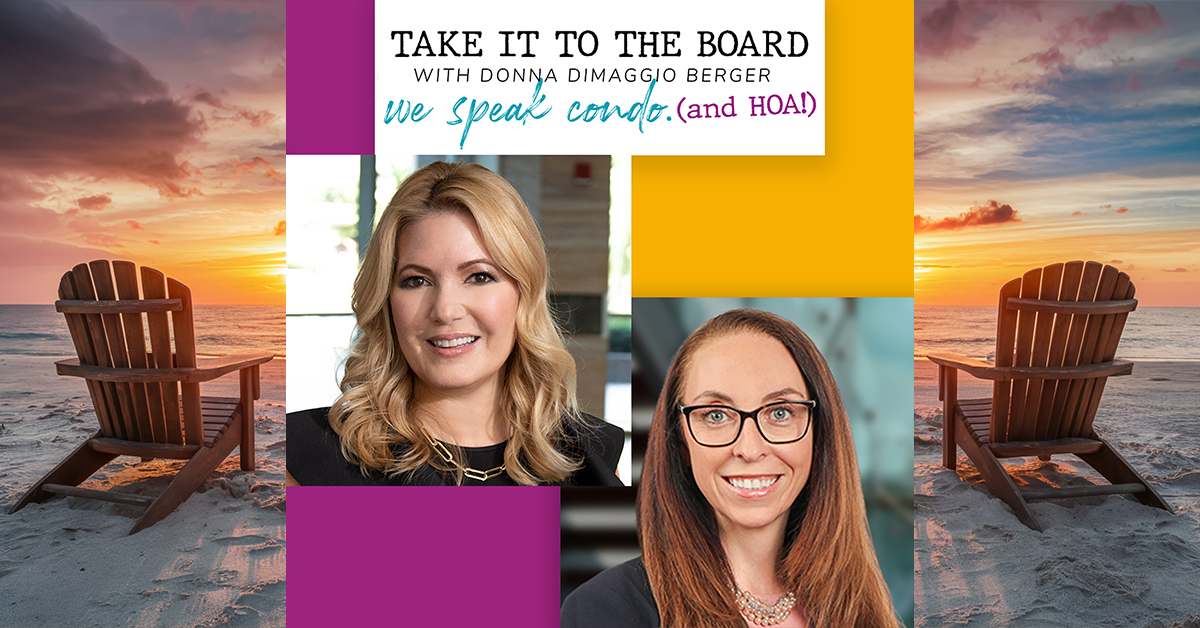
Think you know what community association life is all about? Think again. Residents must obey the rules, directors must follow the law, and managers must keep it all running smoothly. Take It To the Board explores the reality of life in a condominium, cooperative or homeowners’ association, what’s really involved in serving on its board, and how to maintain that ever-so-delicate balance of being legally compliant and community spirited. Leading community association attorney Donna DiMaggio Berger acknowledges the balancing act without losing her sense of humor as she talks with a variety of association leaders, experts, and vendors about the challenges and benefits of the community association lifestyle. Don’t have a streaming app? You can now find all episodes on YouTube! Click here to listen now.
RECENT EPISODES:
-
- What Boards and Managers Need to Know About Residents Aging in Place
- Do EVs, E-Bikes and Other Devices Present a Community-Wide Fire Risk
- The Power Hour For HOA Leaders, with Organizational Strategist Dr. Edward Gurowitz
- SUMMER SERIES: Fan Favorite – Checking In On Background Checks: What’s In, What’s Out and What’s Questionable? with Robert E. Sanchez of Sarma
- How to Run HOA Meetings That Build Trust, Not Tension
- SUMMER SERIES: Fan Favorite – Eyes Everywhere – Understanding Community Surveillance Options with Louis DiGioia of IC Real Time
- SUMMER SERIES: Fan Favorite – Keeping Cool With Jane Gilbert, Chief Heat Officer, Miami-Dade County
- Behind the Scenes of Community Management — What Every Board Should Know
- SUMMER SERIES: Fan Favorite – CERTified Safe: Empowering Community Associations with Dr. Jesse P. Spearo
- SUMMER SERIES: Fan Favorite – The Impact of Construction Next Door on Your Community with Katie Berkey, AICP, Becker & Poliakoff
SUMMER SERIES: Fan Favorite – The Impact of Construction Next Door on Your Community with Katie Berkey, AICP, Becker & Poliakoff
This week, Becker Shareholder Kathleen “Katie” Berkey, AICP, sits down with Donna DiMaggio Berger and explains how she helps clients deal with all sorts of issues related to their property. As Mark Twain once said, “Buy land, they’re not making it anymore,” and truer words have never been spoken. Land remains invaluable and there is often a developer looking to build, renovate, or demolish any given property. When a project like this commences, it can bring a host of headaches and trouble to those living next door.
DID YOU KNOW?
46 Becker Attorneys Recognized in The Best Lawyers in America® 2027 Edition
Becker is proud to announce 46 attorneys have been recognized in the 2027 Edition of The Best Lawyers in America®, one of the legal profession’s most respected peer-reviewed honors.
The 2027 edition recognizes Becker attorneys across a broad range of practice areas, including Community Association Law, Commercial Litigation, Construction Law, Real Estate Law, Government Relations Practice, Land Use and Zoning Law, Banking and Finance Law, and Corporate Law.

If you have new members on your board or a new manager for your community and want them to be part of our Community Update, have them subscribe here:

EDITORS