With the spring season in full swing, it’s a great time for condominium and HOA boards to stay focused and on track. In this issue of CUP, we cover what belongs in meeting minutes, offer practical guidance for depositions, and share important reminders about board recalls to help your association operate smoothly and stay compliant. Don’t miss the latest installment of the Latin Corner, which addresses pet restrictions in community associations.
Electronic voting for condominiums, cooperatives and homeowners’ associations was introduced in 2015. However, now, more than ten years later, some associations still question whether electronic voting is a viable option for their community. Florence King provides everything you need to know in “Benefits and Drawbacks of Electronic Voting.”
They may be invisible, but easements run throughout your community. What are they, and why do you need to understand them? S. David Cooper answers these key questions in “Mind the Invisible Lines: Easements Every Board Encounters.”
In many sections of Chapter 718, Florida Statutes, also known as the Florida Condominium Act, the statute requires an “affidavit.” Mary R. Hawk explains the key statutory situations where sworn statements are necessary to prove notice, compliance, and other critical actions in “When Does the Condominium Act Require an Affidavit?“
THIS CASE highlights how a condominium association’s handling of an accommodation request can lead to liability, damages, and attorneys’ fees. Joseph Markovich highlights the importance of reviewing service animal and emotional support animal policies with legal counsel to ensure associations are following current guidance in “THIS CASE: Bhogaita v. Altamonte Heights Condominium Association, Inc.”
Articles

Benefits and Drawbacks of Electronic Voting
By: Florence King
Electronic voting for condominiums, cooperatives and homeowners’ associations was introduced in Florida in 2015. However, now, more than ten years later, some associations still question whether electronic voting is a viable option for their communities.

Mind the Invisible Lines: Easements Every Board Encounters
By: S. David Cooper
They may be invisible, but easements run throughout your community. What are they, and why do you need to understand them? At some point, nearly every board will encounter an issue that requires an analysis of easement rights to answer the question, “Can we do that?”

When Does the Condominium Act Require an Affidavit?
By: Mary R. Hawk
In many sections of Chapter 718, Florida Statutes, also known as the Florida Condominium Act, the statute requires an “affidavit.” An affidavit is a written declaration or statement of facts, made voluntarily and confirmed by sworn oath or affirmation in the presence of a notary public or other officer having authority to administer an oath.

Bhogaita v. Altamonte Heights Condominium Association, Inc.
765 F.3d 1277 (11th Cir. 2014)
By: Joseph Markovich
THIS CASE shows how a condominium association’s response to a disability accommodation request can potentially lead to liability, damages, and attorneys’ fees. In January 2012, Ajit Bhogaita alleged that Altamonte Heights Condominium Association, Inc. constructively denied his request for a reasonable accommodation after it demanded removal of his dog, which exceeded the condominium’s twenty-five (25) pound pet limit, and then continued seeking additional and increasingly detailed information even after receiving multiple letters from his doctor stating that the dog was prescribed to help him cope with his post-traumatic stress disorder, chronic anxiety, and depression. Although the district court recognized that an association may conduct a meaningful review of an accommodation request, it held that the Association wrongfully persisted in seeking more – and largely irrelevant – information after sufficient support that the dog was needed as a disability accommodation had been provided, rather than timely granting Bhogaita’s request.
The district court concluded that the Association had constructively denied Bhogaita’s accommodation request as the result of making repeated demands for more information once the disability and the need for the requested accommodation were established. Notably, the Association posed questions about why a smaller dog would not suffice and what individualized training the dog had received. The court reasoned that even if some of those inquiries might arguably have been reasonable, other requests went too far. In particular, the court found that the Association had continued seeking details about Bhogaita’s diagnosis, treatment, and related matters after he had already submitted three letters from his doctor supporting his accommodation request. The court determined that the Association had refused to make the requested accommodation, and an appeal followed.
The appellate court affirmed the judgment in Bhogaita’s favor, which incidentally awarded him $5,000.00 in compensatory damages and $127,512.00 in attorneys’ fees. The appellate court found that the Association’s repeated and escalating requests for additional information amounted to a constructive denial of the requested accommodation, and it rejected the Association’s arguments and justifications. r THIS CASE therefore stands as a cautionary tale and a warning that an association’s handling of an accommodation request can carry significant financial consequences when its inquiry exceeds what is reasonably necessary or continues once the request has been sufficiently supported.
THIS CASE draws the line between a lawful review of an accommodation request and conduct that can potentially result in damages and attorneys’ fees. Although associations are permitted to conduct meaningful and interactive reviews of requests for disability accommodations and may ask the requestor to establish the existence of any purported disability that is not obvious, the right to engage in interactive information gathering processes does not allow associations to make unreasonable or overly intrusive demands for information or to delay their consideration of sufficiently supported requests. As the courts recognized here, an indeterminate delay may amount to a constructive denial of the request. An association that fails to follow proper procedures under federal or state housing anti-discrimination laws may face substantial legal consequences, and any association confronted with a request for a disability accommodation should promptly consult association counsel on the proper steps to take.
Associations should also be aware that, given recent policy changes announced by the Department of Housing and Urban Development, it is a good time for associations to review any service animal and/or emotional support animal policies that they may have with legal counsel to ensure that they are following the current guidance.
¿VIVE USTED EN UNA COMUNIDAD QUE NO ACEPTA MASCOTAS?

Por: Marty Platts
La mayoría de las asociaciones de comunidad contienen algún tipo de restricción en sus Documentos Rectores. Algunas asociaciones prohíben todo tipo de mascotas. Otras limitan el tipo, número y/o tamaño de las mascotas que los propietarios pueden tener en sus unidades. Y otras asociaciones permiten mascotas, pero solamente en ciertas localidades de la comunidad.
Question of the Month

Q: I am familiar with your articles concerning unit owner rights to attend board meetings. However, I have a question regarding the minutes of board meetings and what should be included in the minutes. There is some controversy within my association concerning how detailed the minutes of the proceedings must be. Can you elaborate?
Donna DiMaggio Berger Shares Insights on Resilience in South Florida Business Journal BizWomen Feature

Becker shareholder Donna DiMaggio Berger is featured in the South Florida Business Journal’s BizWomen “Mentoring Matters” spotlight, where she reflects on the pivotal role resilience has played throughout her career. As host of Becker’s Take It To The Board podcast, Donna shares her perspective on cultivating meaningful relationships, navigating challenges, and paying it forward to the next generation of professionals.
The Best Boards Choose Becker

Your volunteer service on your association’s board of directors does not have to become your full-time job. Becker brings more than five decades of experience representing all types and sizes of communities and guiding them through everyday and high stakes situations. Becker delivers the insights and expertise that allows your board and your management professional to lead with confidence.
For a complimentary consultation, please click here.
‘You’re Going To Be Deposed’: A Practical Guide For First-Time Deposition Witnesses

CAI Central Florida Times
By: Jake Herrel
If you serve on a condo or HOA board long enough, there is a real likelihood you will someday be asked to sit for a deposition in a lawsuit involving your community. A deposition is sworn testimony, taken outside of court but with the same obligation to tell the truth and the same potential impact on your case. The experience is unfamiliar and often stressful, but with the right preparation and mindset, first‑time deponents can feel comfortable and do well in the “hot seat”.
Announcing Becker’s On-Demand Class Library
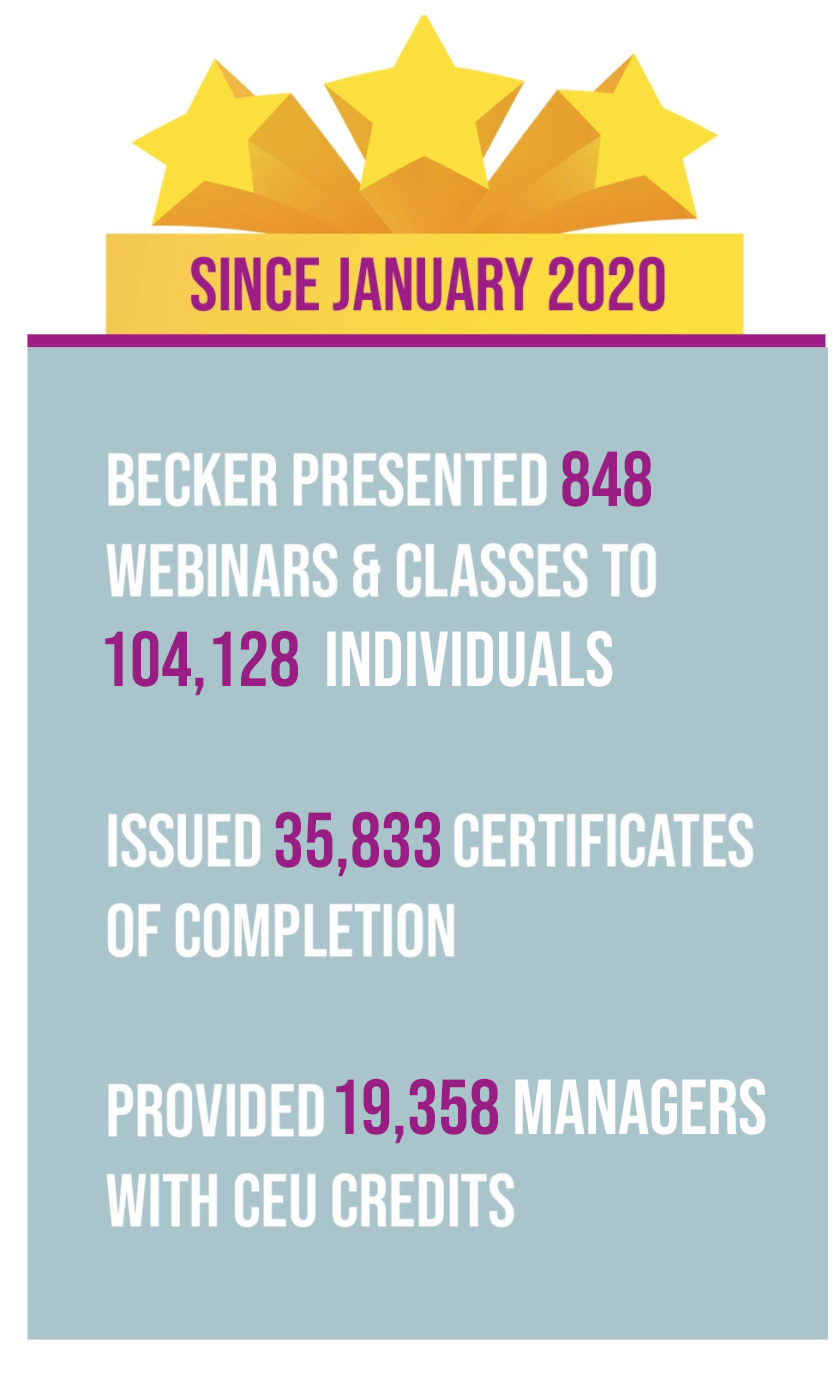
The Florida law mandates that board members of HOAs, Condominiums, and Co-ops take continuing education classes annually.*
Please see our on-demand class library for an extensive list of DBPR approved classes.

Managers and board members of non-clients are welcome to take our courses for $50, unless otherwise specified. Courses are always free for board members of firm clients.
*Breakdown of class requirements for board members and managers of HOA’s, Condominiums, and Co-ops: New Florida Educational Requirements for Board Members and Managers – Frequently Asked Questions
Frequently Asked Questions regarding Becker classes: Becker Classes FAQs


Can They Do That?

Becker’s “Can They Do That” video series tackles some of the unique problems that homeowners and renters face today. We answer your questions, no matter how far-fetched they may seem. From service animals to nudists in your community, we get to the bottom of it and let you know – “Can They Do That?”
Becker Steps Up to the Mic with Podcast,
‘Take It To The Board with Donna DiMaggio Berger’

Think you know what community association life is all about? Think again. Residents must obey the rules, directors must follow the law, and managers must keep it all running smoothly. Take It To the Board explores the reality of life in a condominium, cooperative or homeowners’ association, what’s really involved in serving on its board, and how to maintain that ever-so-delicate balance of being legally compliant and community spirited. Leading community association attorney Donna DiMaggio Berger acknowledges the balancing act without losing her sense of humor as she talks with a variety of association leaders, experts, and vendors about the challenges and benefits of the community association lifestyle. Don’t have a streaming app? You can now find all episodes on YouTube! Click here to listen now.
RECENT EPISODES:
-
- What Actually Moved the Needle for Condos & HOAs in 2025?
- How To Spot, Stop, And Report Modern Scams — with Paul Greenwood, Former Head of Elder Abuse Prosecution Unit
- From Crisis to Compliance– An Engineer’s Explanation of Milestone Inspections and SIRS in Florida Condos
- How Better Business Bureau Tools Can Help Boards Make Safer Hiring Decisions
- A Recall Roadmap — From Petition to Resolution, with Becker’s Jonathan J. Ellis
- What You Need to Know About Conspiracy Theories with University of Miami Professor Joseph E. Uscinski
- Why, When and How to Update Your Governing Documents
- What a Bank Loan Can and Cannot Do For Your Association
- What Boards and Managers Need to Know About Residents Aging in Place
What Boards and Managers Need to Know About Residents Aging in Place

If your community is well run, chances are you have residents who have remained in place for decades but with more condominium and HOA owners choosing to age in place, the services you provide and the manner in which you operate your community naturally must change. 24 hour access for caregivers, nurses, and aides and the need for uninterrupted electricity to power life saving devices all bring new concerns. So, what should boards and managers do when care becomes part of the everyday community association lifestyle, and how can families avoid a crisis-driven scramble to ensure care for loved ones?
Association Board Recalls: What to Do in the First Five Days

FCAP Managers Report
By: Jonathan R. Zim
If there is one association meeting guaranteed to fill a room, ignite strong opinions, and test the limits of parliamentary procedure, it is a recall meeting. Recalls have a way of transforming otherwise quiet communities into high-stakes forums where every vote, signature, and procedural step is critical.
This article discusses the recall process generally as it applies to condominium associations, homeowners’ associations, and cooperative associations, focusing on those procedures that are substantially similar across all three forms of these community associations.
DID YOU KNOW?
Becker Has More Florida Bar Board Certified Attorneys in Business Litigation, Construction, Real Estate, and Condominium & Planned Development Law Combined Than Any Other Law Firm in Florida
Board Certification is the Florida Bar’s highest level of recognition for competence, expertise, and professionalism, a distinction earned by only 5% of its attorney members. This elite credential requires rigorous examinations, thorough peer review, and ongoing education, and is the highest mark of excellence in the practice of law.

If you have new members on your board or a new manager for your community and want them to be part of our Community Update, have them subscribe here:

EDITORS