Summer is a busy time for many Florida community associations, making it especially important for boards and managers to stay current on evolving legal and operational issues. In this issue of CUP, we cover affidavit requirements, handling water leaks, and cybersecurity best practices to help associations manage risk. Don’t miss our featured podcast episode, which goes behind the scenes of community management to explore one management company’s perspective on governance, compliance, contracts, constant legislative change, and real-world challenges.
Florida House Bill 797 significantly revises Section 617.0832 of the Florida Statutes, creating a modernized framework for addressing director conflict-of-interest transactions. For condominium and homeowners’ associations, these changes are particularly important because it requires association boards to comply with Chapter 617’s conflict-of-interest standards. Bryony Swift reviews the new statutory framework in “New Conflict-of-Interest Rules Under HB 797 Raise the Stakes for Association Directors.”
The 2026 legislative session did not result in an abundance of legislation amending the statutes governing condominium, cooperative, and homeowners’ associations. One notable exception, however, is an amendment to Section 720.3035, Florida Statutes. In ” The HOA Architectural Control Statute Has Again Been Amended,” Yeline Goin explains these statutory changes.
Florida condominiums are often created with provisions granting a right of first refusal (ROFR) and/or a right to approve a future purchaser or occupant within the declaration of condominium. Jose Luis Baloyra explains how these provisions work, when they apply, and why strict compliance is essential in “Condominium Association Preemptive Rights Explained: What Is a Right of First Refusal and Is It the Same as a Right of Approval?”
For associations, developers, and purchasers of undeveloped condominium property, assessment obligations may depend on when the declaration was recorded, which version of the Condominium Act applies, and the precise words used to define “unit” or “condominium parcel.” Joey Markovich discusses the important considerations surrounding “phantom units,” including how declaration language and statutory changes may impact assessment obligations in “THIS CASE: Welleby Condominium Ass’n One, Inc. v. William Lyon Co.”
Articles

New Conflict-of-Interest Rules Under HB 797 Raise the Stakes for Association Directors
By: Bryony G. Swift
Florida House Bill 797 (2026) significantly revises Section 617.0832 of the Florida Statutes, creating a modernized framework for addressing director conflict-of-interest transactions. For condominium and homeowners’ associations, these changes are particularly important because Sections 718.3027 and 720.3033 expressly require association boards to comply with Chapter 617’s conflict-of-interest standards.

The HOA Architectural Control Statute Has Again Been Amended
By: Yeline Goin
The 2026 legislative session did not result in an abundance of legislation amending the statutes governing condominium, cooperative, and homeowners’ associations. One exception is an amendment to Section 720.3035, Florida Statutes, involving architectural control covenants and homeowners’ associations (“HOAs”), which was adopted as part of House Bill 803 (HB 803), and which became effective on July 1, 2026.

Florida condominiums are often created with provisions granting a right of first refusal (ROFR) and/or a right to approve a future purchaser or occupant within the declaration of condominium. Section 718.104(5), Florida Statutes, provides that the declaration of condominium, as originally recorded or as amended, may include covenants and restrictions regarding the transfer of units “permitted by law with reference to real property.” Under Florida law, the right of first refusal is deemed reasonable if based on market price or appraised value.
Welleby Condominium Ass’n One, Inc. v. William Lyon Co.
522 So.2d 35 (Fla. 4th DCA 1987)
By: Joseph Markovich
Whether unimproved land shown in condominium documents may be assessed as if it were a completed condominium unit is the issue addressed by THIS CASE. The dispute involved what lawyers in this field sometimes refer to as “phantom units” – property identified in condominium documents as contemplated units, but on which no dwelling or apartment has actually been constructed. After the association filed claims of lien against eleven parcels owned by The William Lyon Company for unpaid maintenance assessments, the developer defended on the ground that the unbuilt parcels were not assessable “condominium units” or “condominium parcels” under the declaration. To resolve the dispute, the Fourth District Court of Appeal examined the Condominium Act provisions in effect when the declaration was recorded and compared them with the wording of the declaration itself.
The court’s analysis turned on the statutory definition of “unit” then in effect. Section 711.03(15), Florida Statutes, later recodified as Section 718.103(16) and currently codified at Section 718.103(31), provided that a unit could consist of improvements, land, or land and improvements together, as specified in the declaration. That statutory language made the declaration critical. The declaration did not impose assessments generally against all land shown in the condominium documents. Instead, it imposed assessments against “condominium parcels,” which it defined as an apartment together with its appurtenant share of the common elements. The declaration further defined an apartment or unit as an individual private dwelling.
Because the developer’s property consisted only of vacant, unimproved land, the court concluded that it was not an assessable condominium parcel under the declaration. The association therefore had no legal authority to levy assessments against the property, and the liens were declared illegal, null, and void. Importantly, THIS CASE was not a broad holding that phantom units can never be assessed. For example, in the 1986 appellate court decision Hyde Park Condo. Ass’n v. Estero Island Real Estate, Inc., 486 So.2d 1 (Fla. 2d DCA 1986), the court held that unimproved parcels constituted assessable units under a different statutory framework and different governing documents. By contrast, THIS CASE was a declaration-driven decision: under the statutory definition of “unit” applicable when the declaration was recorded, a unit could consist of land, improvements, or both, as specified in the declaration; because the declaration defined the assessable interest as a dwelling it excluded raw, unconstructed land.
For associations, developers, and purchasers of undeveloped condominium property, the lesson from THIS CASE is that assessment obligations may depend on when the declaration was recorded, which version of the Condominium Act applies, and the precise words used to define “unit” or “condominium parcel.” That lesson is especially important because Florida courts have continued to address related phantom-unit issues, including whether declaration language includes raw land within the definition of a unit, whether ambiguous declaration language precludes summary judgment, whether unbuilt units are treated differently for ordinary assessments than for deferred maintenance reserves, and whether statutory changes alter the analysis. Given the complex nature of these disputes, those involved should retain the services of an attorney qualified to provide proper guidance.
Question of the Month

Q: I have a question regarding affidavits. I am the Secretary of my condominium association and am sometimes asked to sign affidavits for the mailing of meeting notices and similar documents. When are these actually required?
Becker’s Construction Attorneys Stand Out in Chambers USA Florida Rankings

We are proud to recognize Steven B. Lesser on being ranked Tier 1 by Chambers USA in both Construction Law and Construction Mediation. Steven is the only attorney in Florida to earn Tier 1 recognition in both categories, underscoring his exceptional leadership and longstanding impact on the construction industry.
We also celebrate Becker shareholders Sanjay Kurian and Aaron J. Pruss for being the only Construction attorneys ranked by Chambers and Partners USA in Southwest Florida, from Sarasota to Naples.
These distinctions highlight the strength of Becker’s nationally recognized Construction Law & Litigation Practice, which continues to be recognized among the country’s leading construction law teams for delivering strategic counsel and innovative solutions to clients nationwide.
Community association boards and managers should ensure that their communities have adequate disaster planning measures in place as hurricane season approaches. To help you in weathering the storm, check out Becker’s Hurricane Guide which provides important tips and information to help protect your community.
For more information, contact your Becker attorney.
Dealing with A Water Leak

FCAP Managers Report
By: Nicolas M. Jimenez
When a water leak occurs, many condominium associations prioritize figuring out who is responsible for the water leak and the resulting damages. However, in most cases, that is the wrong approach when dealing with a water leak.
Instead, if a water leak occurs, your condominium association should focus on engaging professionals to stop the leak, such as a plumber, as well as placing its insurance carriers and counsel on notice of the leak. That is because, regardless of who caused the water leak, the condominium association has a duty to protect the condominium, as well as carry adequate property insurance as to same.
Announcing Becker’s On-Demand Class Library

The Florida law mandates that board members of HOAs, Condominiums, and Co-ops take continuing education classes annually.*
Please see our on-demand class library for an extensive list of DBPR approved classes.

Managers and board members of non-clients are welcome to take our courses for $50, unless otherwise specified. Courses are always free for board members of firm clients.
*Breakdown of class requirements for board members and managers of HOA’s, Condominiums, and Co-ops: New Florida Educational Requirements for Board Members and Managers – Frequently Asked Questions
Frequently Asked Questions regarding Becker classes: Becker Classes FAQs
New Class! Mastering Special Assessments – When Reserves Aren’t Enough!
Take our online Special Assessments class and watch on your schedule. This class outlines the special assessment process for funding construction projects, collateralizing loans, funding SIRS, addressing operating budget deficiencies among other association needs. Attendees will learn the conditions precedent to adopting a collectible special assessment from all owners.
CALL Alert: House Bill 797

House Bill 797, consisting of 327 pages was signed by Governor Desantis June 25, 2026 to become law July 1, 2026. This is the first significant rewrite of Florida Not-For-Profit Corporation Act (“Chapter 617”) in over fifteen years. As of July 1st, 2026, it will now be called the Florida Nonprofit Corporations Act. The new law is dominated by considerations to align Chapter 617 with the Florida Business Corporation Act, Chapter 607, Model Non-Profit Corporation Act and the Model Non-Profit Corporation Act. While most community associations in Florida are Chapter 617 corporations, not every provision within Chapter 617 applies to community associations. Therefore, extreme caution must be taken considering the new provisions found in Chapter 617.
Can They Do That?

Becker’s “Can They Do That” video series tackles some of the unique problems that homeowners and renters face today. We answer your questions, no matter how far-fetched they may seem. From service animals to nudists in your community, we get to the bottom of it and let you know – “Can They Do That?”
Q&A: Becker’s Nataly Gutierrez Vazquez Discusses Today’s Community Association Landscape

In a recent Q&A with CityBiz, Becker shareholder Nataly Gutierrez Vazquez shares her perspective on the evolving challenges facing condominium and homeowners’ association boards across South Florida. Drawing on her experience as a Board Certified attorney in Condominium & Planned Development Law, Vazquez discusses the impact of post-Surfside regulations, rising insurance and reserve funding requirements, hurricane preparedness, governance best practices, and the future of community association law. She also offers practical guidance to help association boards navigate today’s increasingly complex legal and operational landscape.
Becker Steps Up to the Mic with Podcast,
‘Take It To The Board with Donna DiMaggio Berger’
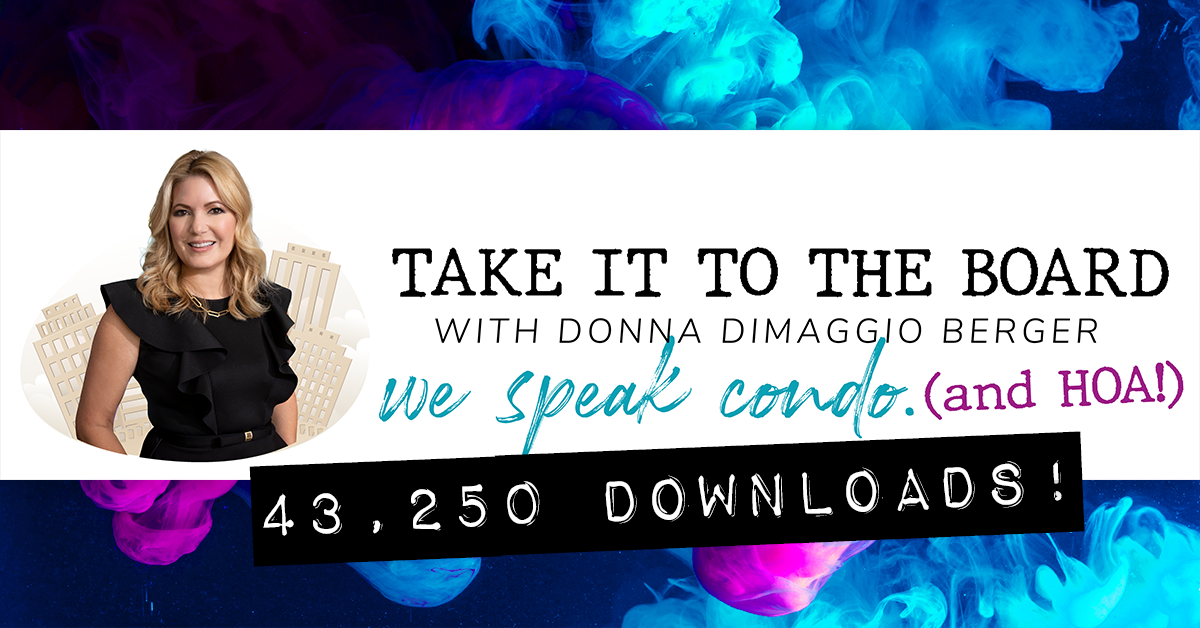
Think you know what community association life is all about? Think again. Residents must obey the rules, directors must follow the law, and managers must keep it all running smoothly. Take It To the Board explores the reality of life in a condominium, cooperative or homeowners’ association, what’s really involved in serving on its board, and how to maintain that ever-so-delicate balance of being legally compliant and community spirited. Leading community association attorney Donna DiMaggio Berger acknowledges the balancing act without losing her sense of humor as she talks with a variety of association leaders, experts, and vendors about the challenges and benefits of the community association lifestyle. Don’t have a streaming app? You can now find all episodes on YouTube! Click here to listen now.
RECENT EPISODES:
-
- Why, When and How to Update Your Governing Documents
- What a Bank Loan Can and Cannot Do For Your Association
- What Boards and Managers Need to Know About Residents Aging in Place
- Do EVs, E-Bikes and Other Devices Present a Community-Wide Fire Risk
- The Power Hour For HOA Leaders, with Organizational Strategist Dr. Edward Gurowitz
- SUMMER SERIES: Fan Favorite – Checking In On Background Checks: What’s In, What’s Out and What’s Questionable? with Robert E. Sanchez of Sarma
- How to Run HOA Meetings That Build Trust, Not Tension
- SUMMER SERIES: Fan Favorite – Eyes Everywhere – Understanding Community Surveillance Options with Louis DiGioia of IC Real Time
- SUMMER SERIES: Fan Favorite – Keeping Cool With Jane Gilbert, Chief Heat Officer, Miami-Dade County
- Behind the Scenes of Community Management — What Every Board Should Know
Behind the Scenes of Community Management — What Every Board Should Know
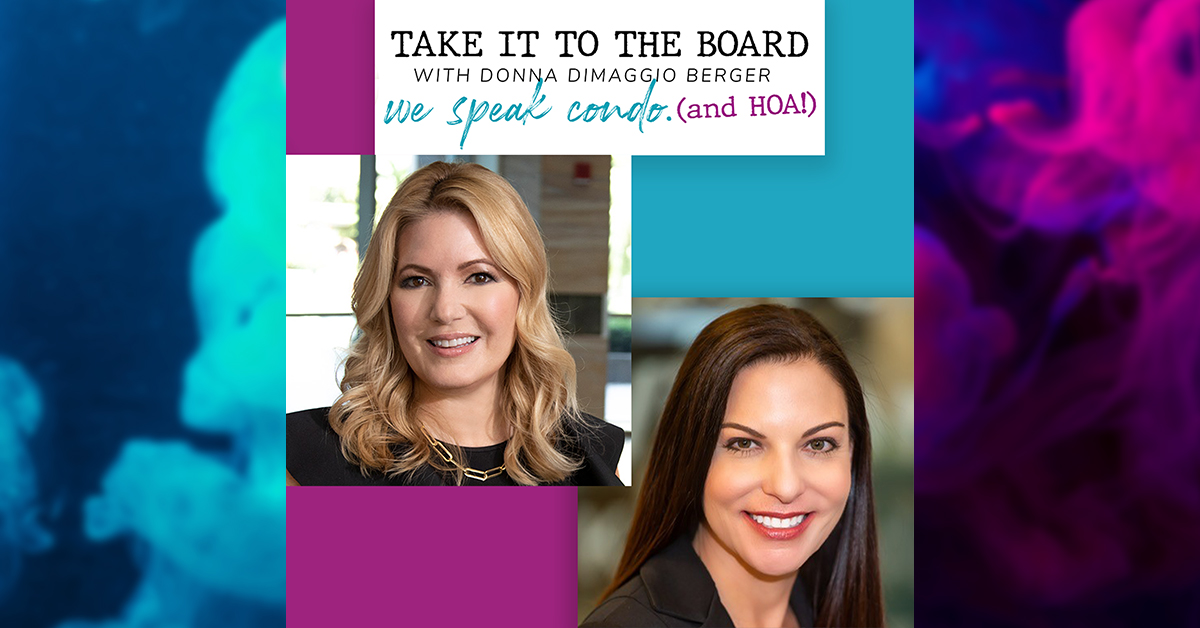
Your management company is involved in almost everything that happens in your community association, yet most boards only see a small slice of what’s going on behind the scenes. In this week’s episode of Take It To The Board, host Donna DiMaggio Berger sits down with Mara Jockers, in-house counsel for FirstService Residential, to get the management company perspective on governance, compliance, contracts, perpetual legislative change and the real-world risks that keep both boards and their management team up at night!
Best Cybersecurity Practices for Community Associations: Managing Risk in a Digital Environment

Florida Community Association Journal
By: S. David Cooper
This article could have been called “Phishing and Hacking and Ransomware, Oh My!” Estimates range from thousands to millions of cyberattacks occurring every day around the world, and community associations and their vendors are prime targets.
Community associations increasingly rely on digital technology for their operations. Official records are stored electronically. Banking records are accessible online, and financial transactions are completed over the internet. Online payment systems and cloud-based property management systems have helped increase efficiency and convenience throughout the industry, but they have provided malicious actors with access and opportunities they have never previously had. Boards and vendors alike must recognize that cybersecurity is not just for IT departments of Fortune 500 companies; it is a matter of proper governance and risk management.
DID YOU KNOW?

18 Becker Attorneys in Florida Were Recognized in 2026 Super Lawyers and Rising Stars
Becker is pleased to announce that 18 of the firm’s attorneys in Florida have been selected for inclusion in the 2026 editions of Florida Super Lawyers and Florida Rising Stars.
The annual Super Lawyers lists recognize outstanding lawyers who have attained a high degree of peer recognition and professional achievement, an honor that recognizes the top 5% of the total lawyers in any given state. The selection process is based on peer nominations, independent research, and evaluations by a highly credentialed panel of attorneys. The Rising Stars list recognizes the top 2.5 percent of attorneys in Florida who are either 40 years old or younger or have been practicing law for 10 years or less. Steven B. Lesser, Chair of Becker’s Construction Law and Litigation practice, was also named a top Super Lawyer in Florida for his area of expertise.
If you have new members on your board or a new manager for your community and want them to be part of our Community Update, have them subscribe here:

EDITORS