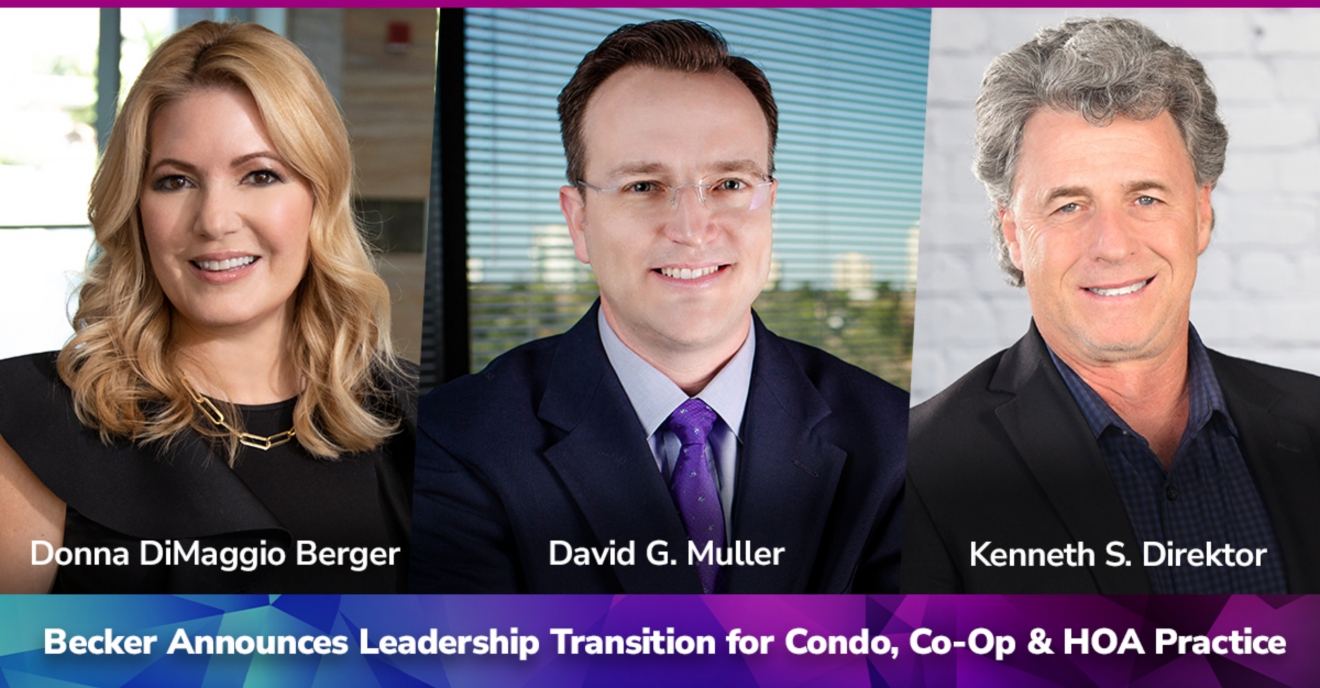
Becker is pleased to announce a planned, strategic leadership transition within its Condo, Co-Op & HOA practice, as Kenneth S. Direktor assumes the position of Chair Emeritus.
In this Issue
September is here, bringing a renewed focus on planning, priorities, and preparation. As Florida communities look ahead to the busy season, this issue of CUP highlights key topics to help boards stay informed and proactive. From election questions and committees to effective communication and understanding artificial intelligence, we have something for you. We also feature Becker’s Legal Update online class, which reviews new laws affecting associations and helps board members meet Florida’s annual legal update requirement. Don’t miss Resilience: Essays by Women in Law, a collection of personal essays authored by women attorneys and professionals across the firm.
Florida Statutes have increasingly emphasized transparency in recent years, particularly in how community association boards communicate with and provide information to their members. But the legislature also recognizes the need for some association records to remain restricted and inaccessible to members. Florence King breaks down the records that remain privileged or otherwise exempt in “Association Records That Are Not Available for Inspection.”
Both Chapter 718 and Chapter 720, Florida Statutes, encourage, recommend, and in some situations even require mediation. Practically speaking, mediation is a supervised settlement negotiation that allows parties to attempt to resolve disputes without the need for litigation. Brandon R. McDowell explains what boards should expect before, during, and after mediation in “What to Expect – Pre-Suit Mediation Edition.”
Florida House Bill 797 creates a comprehensive statutory framework governing derivative actions under newly created Sections 617.0741 through 617.0747 of the Florida Nonprofit Corporations Act. The new law establishes formal procedures for bringing derivative claims and creates new responsibilities for association boards. Bryony G. Swift highlights everything you need to know in “A New Framework for Derivative Lawsuits Against Community Association Boards.”
Contractual privity and economic damages, standing alone, do not invoke the economic loss rule outside products liability. Florida courts, however, have since questioned the application and effects of the rule in particular circumstances, and the scope of the independent-tort requirement remains unsettled. In “THIS CASE: Tiara Condo. Ass’n, Inc. v. Marsh & McLennan Cos.,” Joseph Markovich emphasizes why associations should obtain qualified legal counsel before asserting or evaluating claims affected by the decision.
Articles

Association Records That Are Not Available for Inspection
By: Florence King
Most people who live in Florida live in some form of a residential development that is typically managed by a community association that governs, maintains, and administers the development. In Florida, community associations are regulated by Florida Statutes, which have increasingly emphasized transparency in recent years, particularly with regard to records that are made and maintained by community associations.

What to Expect – Pre-Suit Mediation Edition
Both Chapter 718 and Chapter 720, Florida Statutes, encourage, recommend and in some situations even require pre-suit mediation. But what is mediation? Legally speaking, mediation is a type of Alternative Dispute Resolution (a/k/a ADR). Practically speaking, mediation is a supervised and confidential settlement negotiation. Pre-suit mediation is a process by which parties attempt to resolve disputes without the need for litigation. But what does that mean and what should the Board expect?
A New Framework for Derivative Lawsuits Against Community Association Boards
By: Bryony G. Swift
Florida House Bill 797 (2026) creates a comprehensive statutory framework governing derivative actions under newly created Sections 617.0741 through 617.0747 of the Florida Nonprofit Corporations Act. Because most Florida condominium, cooperative, and homeowners’ associations are organized as nonprofit corporations under Chapter 617, these provisions will have direct consequences for community associations throughout the state.
Tiara Condo. Ass’n, Inc. v. Marsh & McLennan Cos., 110 So.3d 399 (Fla. 2013)
By: Joseph Markovich
Whether Florida’s economic loss rule barred a condominium association’s tort claims against its insurance broker, where the parties were in contractual privity and the association sought solely economic damages, is the issue addressed by THIS CASE. The economic loss rule is a judicially created doctrine that historically limited tort recovery for certain economic losses, particularly where contract or warranty principles supplied the appropriate remedy. Tiara Condominium Association (“Tiara”) retained Marsh & McLennan (“Marsh”) to procure condominium insurance coverage. After Hurricanes Frances and Jeanne damaged the condominium in 2004, Tiara alleged that it undertook more expensive remediation in reliance on Marsh’s assurance that its nearly $50 million windstorm policy limit applied per occurrence rather than in the aggregate. When Citizens Property Insurance Corporation (“Citizens”) took the contrary position, Tiara settled its coverage claim for less than its remediation cost and pursued, among other claims, negligence and breach of fiduciary duty against Marsh.
Before THIS CASE, Florida’s economic loss rule had two principal applications. The rule originated in products liability, where it generally prevented recovery in tort for purely economic losses when a defective product damaged only itself. Over time, however, Florida courts also applied a contractual-privity version of the rule. Under that version, a party to a contract could be barred from seeking tort damages for economic loss arising from the contractual relationship, on the rationale that the parties’ agreement had allocated the relevant risks and remedies. The rule’s expansion beyond products liability – and the resulting uncertainty over its proper application – provided the context for the question certified in THIS CASE.
The Florida Supreme Court answered the certified question in the negative, holding that the economic loss rule applies only in products liability case and receding from prior decisions to the extent they applied the rule elsewhere. The Court concluded that the contractual-privity version of the rule no longer barred Tiara’s negligence and fiduciary-duty claims merely because Tiara and Marsh had a contract and Tiara sought economic losses. The Eleventh Circuit consequently vacated summary judgment on those claims and remanded them for reconsideration.
The lesson from THIS CASE is that contractual privity and economic damages, standing alone, do not invoke the economic loss rule outside products liability. Florida courts, however, have since questioned the application and effects of the rule in particular circumstances, and the scope of the independent-tort requirement remains unsettled. Justice Pariente explained in concurrence that a plaintiff must still establish a tort independent of the alleged breach of contract, and subsequent decisions have treated the boundaries of that requirement as developing. Because the viability of a tort claim may depend on the parties’ agreement, the source of the alleged duty, and the specific conduct and damages at issue, associations and other parties should obtain qualified legal counsel before asserting or evaluating claims affected by THIS CASE.
Question of the Month
Q: The election for the board of directors of my homeowners’ association is coming up in a few weeks. Several candidates held a meet-the-candidates event in the community clubhouse, where drinks and snacks were served. Now, some owners are asserting that because we gave people drinks and snacks, we have committed election fraud and are not eligible to serve on the board. Are they correct?
Community association boards and managers should ensure that their communities have adequate disaster planning measures in place as hurricane season approaches. To help you in weathering the storm, check out Becker’s Hurricane Guide which provides important tips and information to help protect your community.
For more information, contact your Becker attorney.
Beyond the Board: How Committees Strengthen Community Governance

FCAP Managers Report
By: Jonathan R. Zim
One of the hallmarks of an effective community association is a board that knows how to engage its members. While the board of directors retains the ultimate authority and fiduciary responsibility for governing the association, committees can be invaluable in assisting the board, increasing owner participation, and bringing specialized knowledge to the decision-making process. Properly utilized, committees not only reduce the workload placed on volunteer directors but also foster transparency, encourage future leadership, and promote a greater sense of community involvement. Of course, the decisions of a board or committee should not replace their responsibility to consult with professionals or experts in particular circumstances, such as attorneys, accountants, engineers, contractors, etc.
Becker’s On-Demand Class Library

The Florida law mandates that board members of HOAs, Condominiums, and Co-ops take continuing education classes annually.*
Please see our on-demand class library for an extensive list of DBPR approved classes.

Managers and board members of non-clients are welcome to take our courses for $50, unless otherwise specified. Courses are always free for board members of firm clients.
*Breakdown of class requirements for board members and managers of HOA’s, Condominiums, and Co-ops: New Florida Educational Requirements for Board Members and Managers – Frequently Asked Questions
Frequently Asked Questions regarding Becker classes: Becker Classes FAQs
Florida Law Mandates that Board Members take a Legal Update class each year!
Join Becker as we examine the changes and challenges in the new laws affecting associations. New responsibilities are now required of board members and managers, and accordingly, the following will be discussed: Videoconferencing, Record Keeping Requirements, Budgeting, Reserves, and more.
Can They Do That?
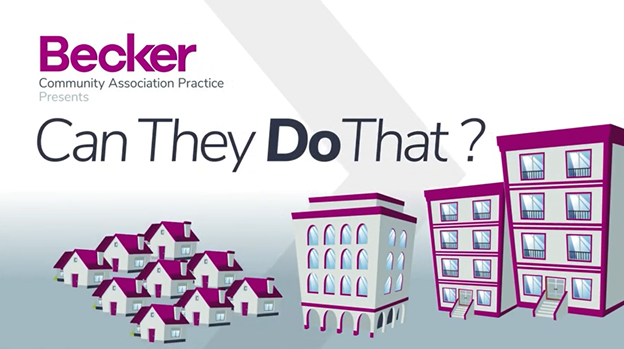
Becker’s “Can They Do That” video series tackles some of the unique problems that homeowners and renters face today. We answer your questions, no matter how far-fetched they may seem. From service animals to nudists in your community, we get to the bottom of it and let you know – “Can They Do That?”
Communication Is One of a Board’s Most Important Responsibilities

Florida Community Association Journal
By: Ramon C. Palacio
Boards of directors of Florida community associations have a fiduciary duty to act in the best interests of their communities. While this responsibility is often associated with budgeting, maintenance, and legal compliance, one area of a board’s responsibilities that often receives less attention is effective communication with the membership, an important means by which boards can better fulfill their fiduciary duties.
Becker Steps Up to the Mic with Podcast,
‘Take It To The Board with Donna DiMaggio Berger’
Think you know what community association life is all about? Think again. Residents must obey the rules, directors must follow the law, and managers must keep it all running smoothly. Take It To the Board explores the reality of life in a condominium, cooperative or homeowners’ association, what’s really involved in serving on its board, and how to maintain that ever-so-delicate balance of being legally compliant and community spirited. Leading community association attorney Donna DiMaggio Berger acknowledges the balancing act without losing her sense of humor as she talks with a variety of association leaders, experts, and vendors about the challenges and benefits of the community association lifestyle. Don’t have a streaming app? You can now find all episodes on YouTube! Click here to listen now.
RECENT EPISODES:
-
- The Power Hour For HOA Leaders, with Organizational Strategist Dr. Edward Gurowitz
- SUMMER SERIES: Fan Favorite – Checking In On Background Checks: What’s In, What’s Out and What’s Questionable? with Robert E. Sanchez of Sarma
- How to Run HOA Meetings That Build Trust, Not Tension
- SUMMER SERIES: Fan Favorite – Eyes Everywhere – Understanding Community Surveillance Options with Louis DiGioia of IC Real Time
- SUMMER SERIES: Fan Favorite – Keeping Cool With Jane Gilbert, Chief Heat Officer, Miami-Dade County
- Behind the Scenes of Community Management — What Every Board Should Know
- SUMMER SERIES: Fan Favorite – CERTified Safe: Empowering Community Associations with Dr. Jesse P. Spearo
- SUMMER SERIES: Fan Favorite – The Impact of Construction Next Door on Your Community with Katie Berkey, AICP, Becker & Poliakoff
- Hidden Workplace Dangers — Navigating Employment Risks for Community Associations
- How to Become a Much Better User of AI!
How to Become a Much Better User of AI!
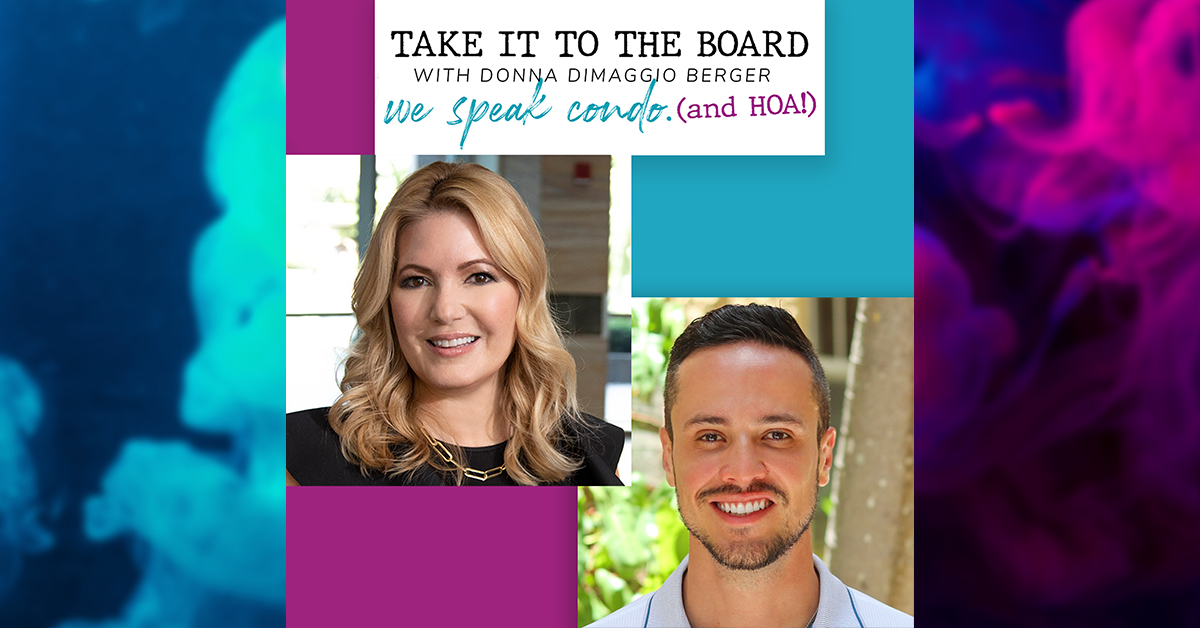
AI generated documents are already sitting in your inbox and maybe even your next board packet, and that’s exactly why we wanted a grounded, practical conversation on how to get the most out of your AI usage and avoid the common mistakes. On this week’s episode of Take It To The Board, host Donna DiMaggio Berger is joined by Thiago Ferreira, founder and CEO of Elevate AI Consulting and an instructor of human-centered AI at the University of Miami, to break down what these tools can actually do for boards, managers, vendors, and residents.
DID YOU KNOW?
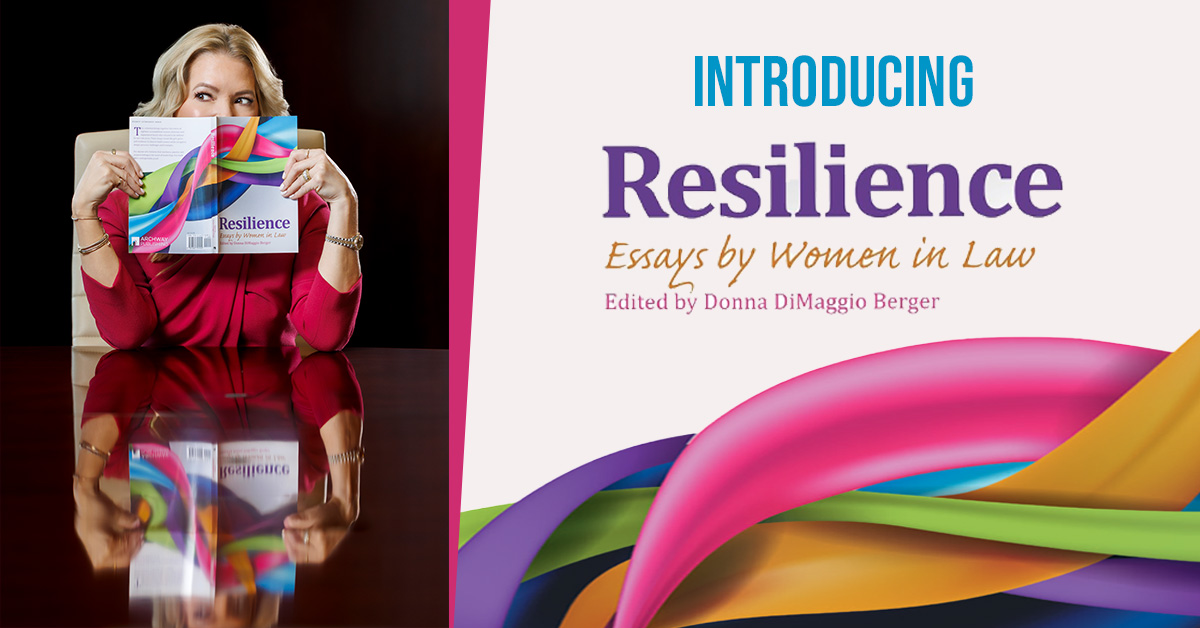
Becker Releases Resilience: Essays by Women in Law, Celebrating the Stories and Perseverance of Women Across the Firm
Conceptualized and edited by Becker shareholder Donna DiMaggio Berger, Resilience: Essays by Women in Law, brings together stories of perseverance, leadership, mentorship and personal growth from women whose experiences have shaped their careers and enriched the firm’s culture. Through candid reflections on overcoming obstacles, balancing professional and personal responsibilities, and forging paths in the legal profession, the authors offer readers a look at the resilience that defines women in law.
Contributors include women from a broad range of Becker’s legal and business disciplines, each offering a personal perspective on resilience, determination and leadership. The collection reflects the diversity of backgrounds and experiences that have helped shape Becker’s collaborative culture and longstanding commitment to excellence.

If you have new members on your board or a new manager for your community and want them to be part of our Community Update, have them subscribe here:

EDITORS