With Hurricane Season underway, now is the perfect time to ensure your community is prepared. From taking proactive steps before a storm arrives to planning for electric vehicle safety during severe weather events, this issue of CUP offers valuable guidance to help your association navigate hurricane season. You’ll also find articles on board meeting frequency requirements, navigating support-animal housing regulations, and conducting legally compliant video conference meetings. Be sure to check out our featured podcast episode discussing important considerations for community surveillance systems.
The Office of the Condominium Ombudsman serves as an important resource for condominium owners, board members, and associations throughout Florida. From assisting with dispute resolution and owner education to overseeing certain election-related matters, the Ombudsman plays a unique role in the condominium governance process. Michelle H. Kaiser explains everything you need to know about the Ombudsman’s role and authority in “Understanding the Role, Duty, and Powers of Florida’s Condominium Ombudsman.”
As more residents use medical marijuana, condominium associations are increasingly faced with questions about how their smoking restrictions apply. While associations may have authority to regulate smoking in common areas and units, medical marijuana use can introduce additional legal considerations, including potential fair housing obligations. Elizabeth A. Lanham-Patrie explains what associations need to know in “Can a Condominium Association Prohibit Medical Marijuana Smoking in the Same Way It Can Prohibit Cigarette Smoking?”
Brandon McDowell explains four things to know about pre-mediation, including how mediation works as a supervised negotiation, who is eligible to participate, what types of disputes may be mediated, and the key statutory timelines associations must follow. Understand what to expect and how to prepare for the process in this practical video, “4 Things to Know About Pre-Suit Mediation.”
Whether construction of condominium property must be substantially completed to trigger obligations under a condominium declaration is the issue addressed by THIS CASE. Joseph Arena explains how the recording of a declaration and phased amendments affects condominium obligations in “THIS CASE: Winkelman v. Toll.”
Articles

Understanding the Role, Duty, and Powers of Florida’s Condominium Ombudsman
The Office of the Condominium Ombudsman is an office of the Division of Florida Condominiums, Timeshares, and Mobile Homes (“Division”) of the Department of Business and Professional Regulation (“DBPR”). The Ombudsman is a bureau chief of the Division, is appointed by the DBPR’s Secretary, and serves at the pleasure of the Governor.

By: Elizabeth A. Lanham-Patrie
A condominium association may prohibit cigarette smoking in the common elements/common areas by adopting a Rule. An association may also prevent cigarette smoking on a balcony or patio, which are usually limited common elements. If such areas are limited common elements, then, just like with the common elements, the association may adopt a Rule prohibiting smoking on the balcony or patio.
4 Things to Know About Pre-Suit Mediation
In this video, Brandon McDowell explains four key things to know about pre-mediation, including how mediation functions as a supervised negotiation, who is eligible to participate, what types of disputes may be mediated, and the important statutory timelines associations must follow. He also discusses what happens during the process, from the opportunity for parties to meet face-to-face and attempt resolution to the requirements for reaching a written agreement or declaring an impasse. Watch the full video to better understand how to prepare for mediation and what to expect if your association enters the process.
Winkelman v. Toll
661 so. 2d 102 (Fla. 4th DCA 1995)
By: Joseph Arena
Whether construction of condominium property needs to be substantially completed to trigger obligations under the condominium declaration is the issue addressed by THIS CASE. The court examined the Condominium Act (Chapter 718, Florida Statutes) carefully and compared it with the applicable condominium declaration for the community at issue, as that declaration had been amended to add phases. After a thorough analysis, the court found that the recording of the condominium declaration and, when applicable, the recording of amendments adding phases is what submits property to the condominium form of ownership, and such recordings are all that is needed to subject property to the obligations set forth in the condominium declaration. THIS CASE holds specifically that the failure to complete construction does not prevent land from being included in the condominium.
The issues underlying the dispute between the parties to THIS CASE arose under Fla. Stat. §718.403 which governs the manner in which condominiums may be developed in phases. The court indicated that amendments to the community’s condominium declaration adding phases to the condominium had been recorded. However, a problem arose after construction of the later phases was not pursued and after the land that was designated within those unbuilt phases was sold. Naturally, the purchaser did not want to pay common expenses and sought a determination that the unbuilt phases were not subject to the condominium form of ownership.
Seizing upon language in the Condominium Act and in the applicable condominium declaration pertaining to the substantial completion of construction, the purchaser argued that the phases that were added to the condominium do not become subject to the obligations of the condominium declaration until the phases are built. The trial court accepted this argument, but the appellate court reversed. The appellate court determined that condominiums are “creatures of statute”, that a condominium is created by the recording of a condominium declaration in the public records, and that, while the substantial completion of construction is addressed within important sections of the Condominium Act, the submission of property to the condominium form of ownership is not conditioned upon construction being completed.
THIS CASE is more than just a footnote in the evolution of lawyers’ understandings concerning condominiums. It indicates that the recording of a condominium declaration that conforms to the requirements of the Condominium Act is all that is needed to transform land into a condominium, and this transformation occurs regardless of what is actually built on the site. Here, when phases were added to condominium by recorded amendments to the condominium declaration, the “die was cast” and the purchaser was unable to wriggle free of the condominium declaration’s obligations even though the land was unimproved at the time it was acquired. Notably, it may warrant being mindful of THIS CASE when unit owners express dissatisfaction with condominium ownership and begin espousing notions of how to escape condominium obligations in ways other than by selling their units.
Question of the Month

Q: At a recent board of directors meeting the board of my homeowners’ association stated that the next board meeting would not be until later this fall. I was under the impression that the board had to meet at least monthly. What is the rule for frequency of board meetings?
JoAnn Nesta Burnett Explores the Changing Rules Governing Support Animals in Housing

In a recent article for Florida Realtors® magazine, Becker shareholder JoAnn Nesta Burnett explores the evolving legal landscape surrounding emotional support and service animals in housing communities, titled “How to Navigate Support-Animal Housing Rules in Florida.” As federal fair housing guidance continues to shift and disability accommodation disputes remain at near-record levels, Burnett examines the challenges facing real estate professionals, housing providers, and buyers alike.
Community association boards and managers should ensure that their communities have adequate disaster planning measures in place as hurricane season approaches. To help you in weathering the storm, check out Becker’s Hurricane Guide which provides important tips and information to help protect your community.
For more information, contact your Becker attorney.
The New Condo Meeting Playbook: Running Legally Compliant Video Conference Meetings in 2026

FCAP Managers Report
By: Nataly Gutierrez Vazquez
During COVID, many condominium associations started using video conference meetings as a daily routine. What began as a temporary fix soon proved to be a useful tool. Video meetings help boost participation, make it easier for seasonal residents to join, let traveling board members stay involved, and keep owners with work, family, mobility, or transportation challenges informed.
Announcing Becker’s On-Demand Class Library
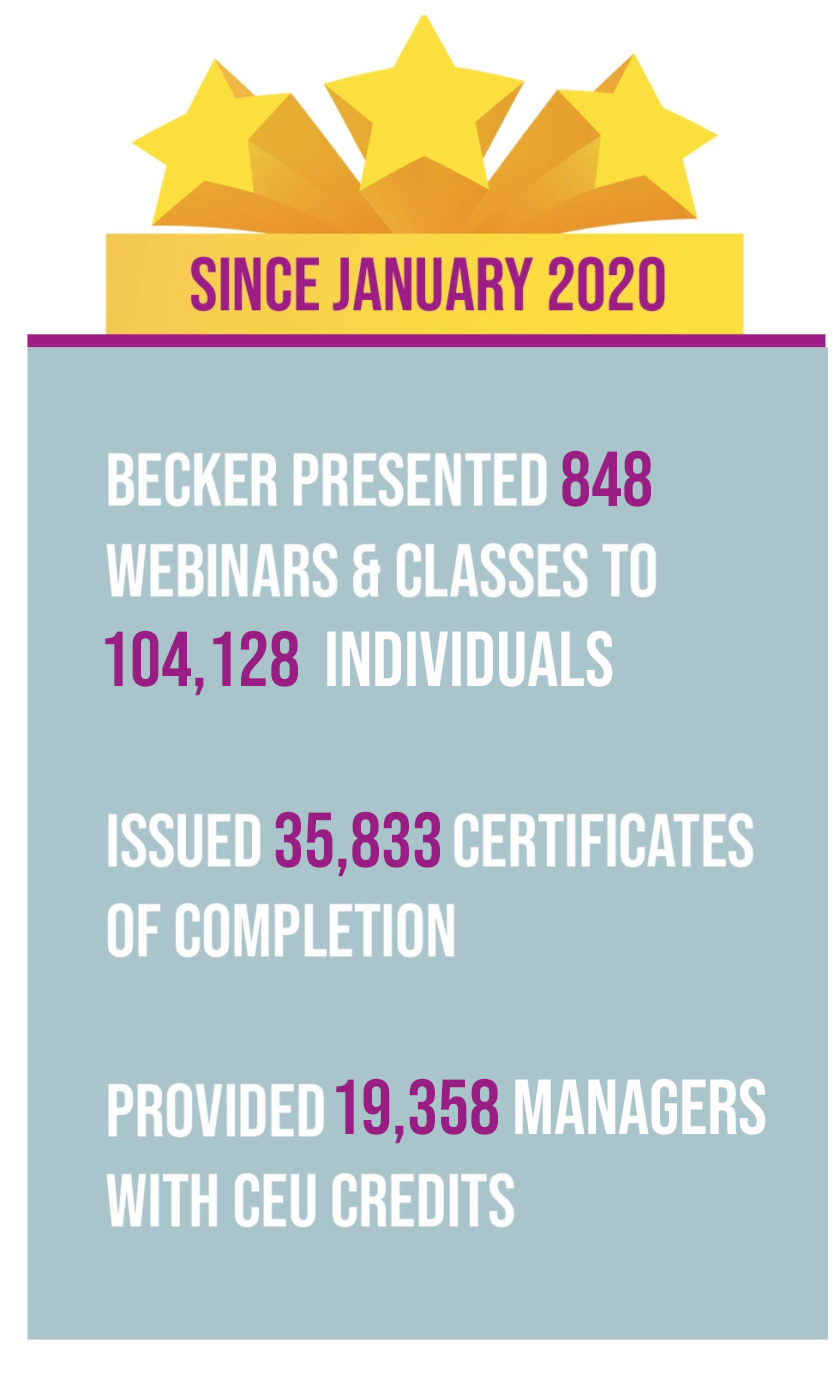
The Florida law mandates that board members of HOAs, Condominiums, and Co-ops take continuing education classes annually.*
Please see our on-demand class library for an extensive list of DBPR approved classes.

Managers and board members of non-clients are welcome to take our courses for $50, unless otherwise specified. Courses are always free for board members of firm clients.
*Breakdown of class requirements for board members and managers of HOA’s, Condominiums, and Co-ops: New Florida Educational Requirements for Board Members and Managers – Frequently Asked Questions
Frequently Asked Questions regarding Becker classes: Becker Classes FAQs


Can They Do That?
Becker’s “Can They Do That” video series tackles some of the unique problems that homeowners and renters face today. We answer your questions, no matter how far-fetched they may seem. From service animals to nudists in your community, we get to the bottom of it and let you know – “Can They Do That?”
Hurricane Season Is Here. What Steps Should Your Board Take Before a Storm Arrives?

For Florida community associations, hurricane preparedness is not optional; instead, it is an essential part of fulfilling the board’s fiduciary responsibilities. The most effective storm response begins long before a hurricane watch or warning is issued.
Boards that take proactive steps now will be in a far better position to protect lives, preserve property, minimize disruption, and accelerate recovery efforts after a storm passes.
Becker Steps Up to the Mic with Podcast,
‘Take It To The Board with Donna DiMaggio Berger’
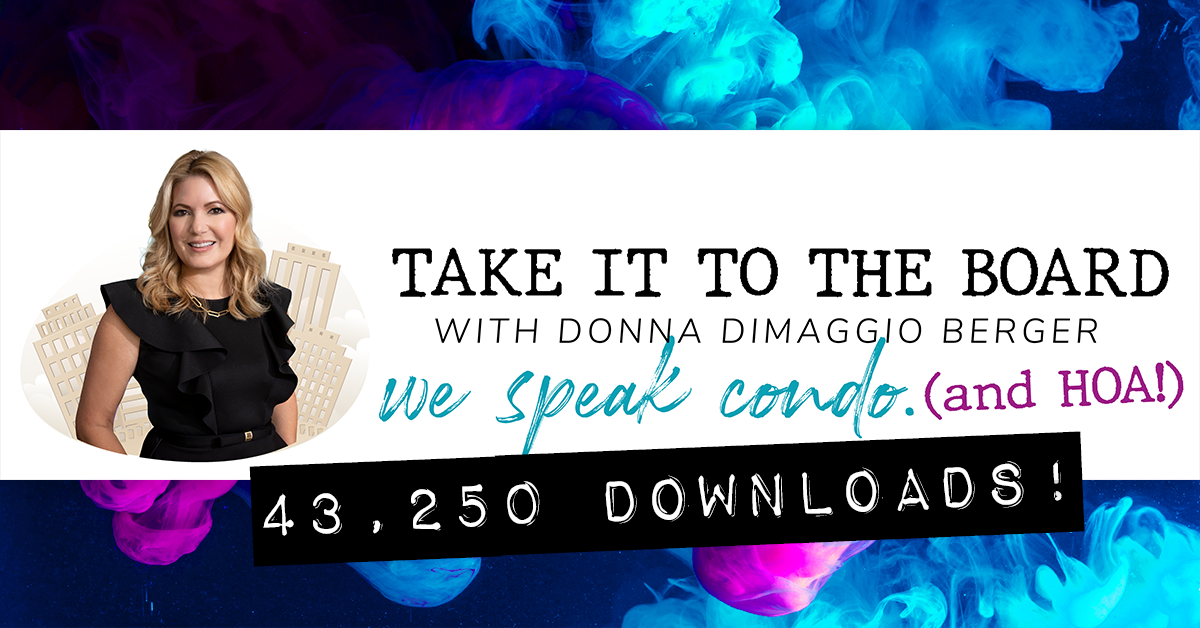
Think you know what community association life is all about? Think again. Residents must obey the rules, directors must follow the law, and managers must keep it all running smoothly. Take It To the Board explores the reality of life in a condominium, cooperative or homeowners’ association, what’s really involved in serving on its board, and how to maintain that ever-so-delicate balance of being legally compliant and community spirited. Leading community association attorney Donna DiMaggio Berger acknowledges the balancing act without losing her sense of humor as she talks with a variety of association leaders, experts, and vendors about the challenges and benefits of the community association lifestyle. Don’t have a streaming app? You can now find all episodes on YouTube! Click here to listen now.
RECENT EPISODES:
-
- A Recall Roadmap — From Petition to Resolution, with Becker’s Jonathan J. Ellis
- What You Need to Know About Conspiracy Theories with University of Miami Professor Joseph E. Uscinski
- Why, When and How to Update Your Governing Documents
- What a Bank Loan Can and Cannot Do For Your Association
- What Boards and Managers Need to Know About Residents Aging in Place
- Do EVs, E-Bikes and Other Devices Present a Community-Wide Fire Risk
- The Power Hour For HOA Leaders, with Organizational Strategist Dr. Edward Gurowitz
- SUMMER SERIES: Fan Favorite – Checking In On Background Checks: What’s In, What’s Out and What’s Questionable? with Robert E. Sanchez of Sarma
- How to Run HOA Meetings That Build Trust, Not Tension
- SUMMER SERIES: Fan Favorite – Eyes Everywhere – Understanding Community Surveillance Options with Louis DiGioia of IC Real Time
SUMMER SERIES: Fan Favorite – Eyes Everywhere – Understanding Community Surveillance Options with Louis DiGioia of IC Real Time

Ever wondered how a camera can pick out a face in the crowd or if that gym security camera is a watchful guardian or an intrusive eye? Discover the intricate dance between security and privacy in our neighborhoods, as host, Donna DiMaggio Berger, sits down with guest Louis DiGioia from IC Real Time. They shed light on the advanced technology that’s safeguarding our communities, from the sharpness of high-resolution cameras to the stealth of thermal imaging. Dive into the heart of today’s surveillance systems and find out just how much protection they can offer to your community association, without crossing the fine line into privacy infringement.
Storm Preparation and Planning for Electric Vehicles

Florida Community Association Journal
By: Joseph Markovich
As hurricane season approaches, electric vehicles (“EVs”) present unique safety considerations when high winds, flooding, and power outages are expected. These concerns become especially important in communities where vehicles are parked in enclosed garages or shared structures. Issues such as whether an EV should remain plugged in inside a garage during a hurricane, and how to handle a vehicle exposed to saltwater or storm surge, require careful, practical planning aimed at reducing risks to both people and property.
DID YOU KNOW?

Becker Recognized in Chambers USA for Construction and General Commercial Litigation; 10 Attorneys Receive Individual Honors
Becker is proud to announce its continued recognition in the 2026 edition of Chambers USA, one of the legal industry’s most respected guides ranking the nation’s leading law firms and attorneys.
Becker’s nationally recognized Construction Practice earned top rankings, reinforcing the team’s longstanding reputation for excellence and industry leadership. The group was ranked nationwide in Construction, placing Becker among only 31 firms recognized at the national level. The practice also earned the highest ranking, Band 1 recognition in Florida, a distinction it has maintained every year since Chambers USA began publishing rankings. It was also recognized in New Jersey for its continued strength and growing presence in the region.
If you have new members on your board or a new manager for your community and want them to be part of our Community Update, have them subscribe here:

EDITORS