As we move into the spring season, we’re reminded that it’s a time to embrace new beginnings and fresh opportunities. In this edition of CUP, we focus on practical insights to help your association navigate change with confidence. Our featured articles cover a range of timely topics, including House Bill 657 and its potential impact on associations, understanding the rules surrounding electronic voting, how to properly navigate a recall petition, and breaking down Florida’s new education requirements for board members. We are also thrilled to welcome our newest Shareholder, Nataly Gutierrez Vazquez, and celebrate our first BoardSmart Masterclass Series graduate.
For those of you living in South Florida, don’t miss Becker’s Industry Appreciation Event on March 19 in Coral Gables! Please join us for an evening of refreshments, meaningful networking, and connection with Becker attorneys who serve community associations throughout Miami-Dade and across Florida. Click here to register.
One of the most important financial decisions facing Florida community associations is how to account for reserve funds. Should your association maintain separate accounts for each reserve component, or combine them into a single pooled fund? Clinton S. Morrell breaks down the advantages and disadvantages of each approach in “To Pool Or Not To Pool? Understanding Straight Line Versus Pooled Reserves in Florida Community Associations.”
Providing remote access to association meetings offers many advantages, including increased participation and transparency, but it also gives meeting leaders an important tool: the ability to mute participants to maintain order and keep discussions on track. Nicolas M. Jimenez explains why it is critical to understand the legal boundaries and best practices surrounding this authority in “The Power to Mute.”
Terminating a condominium in Florida is a complex process with several legal considerations. In “Minority Unit Owners’ Veto Power Over Condo Termination,” Jose Luis Baloyra explains how F.S. 718.117 and the inclusion or absence of Kaufman language in a declaration can affect the unit owner approval process.
Competing arguments over enforcing lien provisions in community declarations were at the heart of THIS CASE. Joseph Arena explains the lasting legacy and legal precedent set for why assessment liens established by a community declaration will almost always overcome owners’ Homestead protections in “THIS CASE: Bessemer v. Gersten.”
Articles

One of the most significant financial decisions facing Florida community associations is how to account for reserve funds. Should your homeowners, condominium or co-op association maintain separate accounts for each reserve component, or combine them into a single pooled fund? This choice affects not only your accounting practices but also your flexibility in managing major repairs and replacements.

There are countless reasons that your community association may benefit from providing remote access to meetings of its members or that of its board of directors. In fact, the availability of remote access alone tends to lead to, at the very least, a positive feeling of increased transparency among the community, due to the ease in which the ongoings of the association can be broadcast and discussed. For the same reason, remote access may also benefit communities that often struggle to obtain the participation of members that only reside in the community part time.

Minority Unit Owners’ Veto Power Over Condo Termination
Termination of a condominium in Florida is a complicated transaction with numerous legal issues at play. F.S 718.117 governs terminations of condominiums and allows termination for economic waste or impossibility or optional termination. Termination because of economic waste or impossibility requires the approval of the lesser of the lowest percentage of voting interests necessary to amend the declaration or as otherwise provided in the declaration for approval of termination. Optional termination requires that at least 80% of the unit owners approve the plan for it to become effective and 5% or more of the unit owners can reject the plan. However, not every declaration of condominium in Florida will incorporate F.S. 718.117 unless it contains Kaufman language so as to incorporate future amendments to the Florida Condominium Act (“as amended from time to time”). When a declaration does not contain Kaufman language and was recorded prior to 2007, the Association must proceed pursuant to the termination provision contained in the declaration. Many associations have previously worked around this impediment by simply amending the declaration to lower the threshold for unit owner approval of a plan of termination.
Bessemer v. Gersten
By: Joseph Arena
Competing arguments for and against enforcing a lien provision in a declaration of restrictions were at issue in THIS CASE. THIS CASE left a lasting legacy and set the legal precedent for why assessment liens that are established by a community declaration will almost always overcome owners’ Homestead protections. In THIS CASE Florida’s Supreme Court held that accepting a deed with actual or constructive notice of lien provisions in a declaration of restrictions subordinates the owner’s property interest and any accompanying Homestead protections to that lien. Thus, homeowners’ associations are able to foreclose liens for unpaid assessments upon Homestead property in most circumstances.
Here, the Gerstens purchased a home from their community’s developer after the developer recorded a declaration of restrictions requiring parcel owners to make recreation land lease payments. The declaration also provided that the developer and its successors had a lien as well as the right to foreclose to secure each home’s payment obligations. The Gerstens were sued over delinquent payments and made several rebuttal arguments including: (1) that there was no pre-existing lien against their home because the developer was not obligated to pay during its prior ownership, (2) that they obtained Homestead status when they bought their home and at the time coinciding with when the lien, according to them, came into existence, and (3) that the timing was such that their Homestead rights prevented their home from being foreclosed.
The court explored these arguments in detail but arrived at a far-reaching conclusion. Namely, that the declaration of restriction was an encumbrance upon the property at the time that the Gerstens purchased their home and that the Gerstens took title subject to the lien for recreation land lease payments described by the declaration. The court held that the Gerstens’ acceptance of their deed was sufficient to create a “contractual lien” that relates back to the date when the declaration of restrictions was recorded. Thus, their Homestead argument failed, and the court set in motion the legal mechanisms that have evolved to allow homeowners’ associations to place liens against and foreclose Homestead property when assessments are delinquent.
Any questions a homeowners’ association may have about its lien rights should be discussed with legal counsel.
Donna DiMaggio Berger Weighs in on House Bill 657 in the Miami Herald

In a recent Miami Herald op-ed, Becker shareholder Donna DiMaggio Berger, a board-certified specialist in condominium and planned development law, examines House Bill 657 and its potential impact on Florida’s homeowners’ associations. Drawing on decades of experience advising community associations and unit owners statewide, Donna cautions that allowing HOAs to dissolve through a supermajority vote is not meaningful reform — but a step toward regulatory retreat that could jeopardize property values, financial stability, and homeowner protections.
Question of the Month

Q: I am an owner in a condominium complex in Naples, Florida. I read your recent article about voting by email and I have additional questions about ballots and proxies. Can ballots and proxies be opened counted in advance of a membership meeting or is an impartial panel required to count them at the meeting and can ballots and proxies be submitted by e-mail and, if so, does it require the Association to designate an official e-mail address for this purpose?
Class Is in Session: The ABC’s of Florida’s Board Member Education Requirements

FLCAJ Magazine
By: Allison L. Hertz
Benjamin Franklin famously said in 1789, “In this world, nothing can be said to be certain, except death and taxes.” Had he lived in a community association in Florida, his quote likely would have read “… except death and taxes and changes in Florida community association law.” There were a voluminous number of bills filed during the 2025 legislative session that dealt with community associations. While the vast majority of these bills will never become law, those that do become law often have major impacts on the daily operations of a community association, ranging from meeting requirements to official records, reserve funding, investment of association funds, community association managers, hurricane protection, and so on. The legislature expects every board member in this state to understand and follow all these laws that change almost every year, in addition to the governing documents of the specific association.
Nataly Gutierrez Vazquez Joins Becker’s Condo, Co-Op & HOA Practice in Miami

Becker is pleased to announce that Nataly Gutierrez Vazquez has joined the firm’s Condo, Co-Op & HOA practice in Miami where she will serve as general and litigation counsel to condominium, cooperative, and homeowners’ associations throughout Florida, providing clients with comprehensive Florida association law guidance to navigate the intricacies of community association regulations. Nataly focuses on managing complex association matters from pre-litigation through trial and advising boards and managers on a broad range of legal and operational issues affecting their communities.
Announcing Becker’s On-Demand Class Library
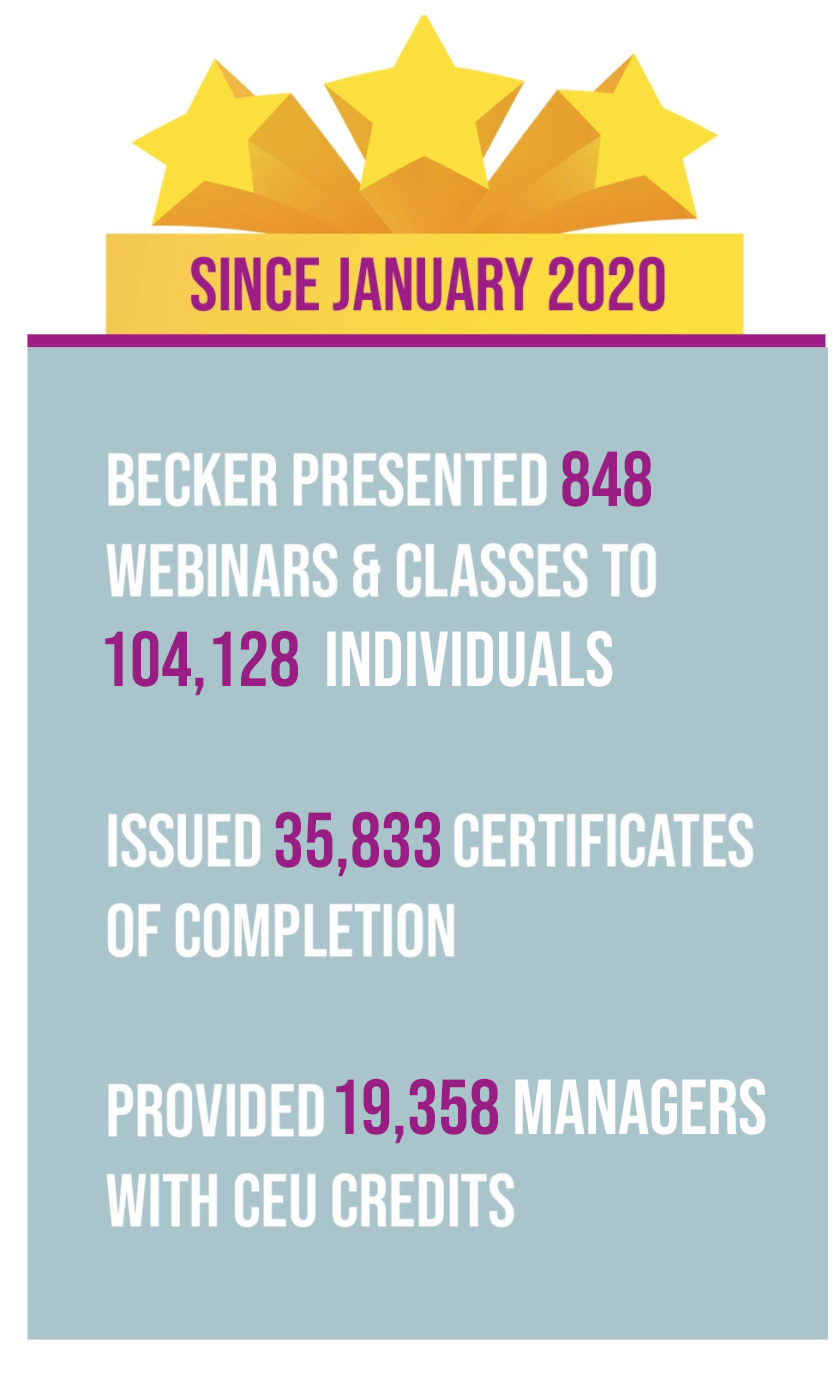
The Florida law mandates that board members of HOAs, Condominiums, and Co-ops take continuing education classes annually.*
Please see our on-demand class library for an extensive list of DBPR approved classes.

Managers and board members of non-clients are welcome to take our courses for $25, unless otherwise specified. Courses are always free for board members of firm clients.
*Breakdown of class requirements for board members and managers of HOA’s, Condominiums, and Co-ops: New Florida Educational Requirements for Board Members and Managers – Frequently Asked Questions
Frequently Asked Questions regarding Becker classes: Becker Classes FAQs
Becker’s First BoardSmart Graduate:
Congratulations David Angelica!
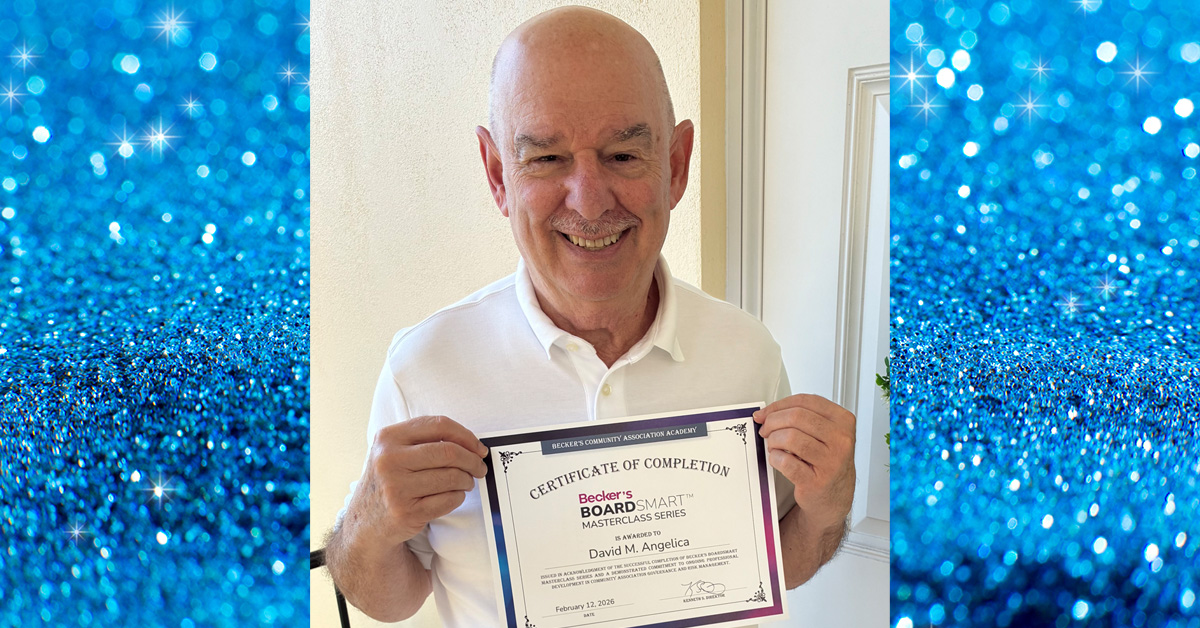
“Having been an LCAM in another state and having served as a past Board President in my Florida Community—now returning to serve as a Board Member again, I have found Becker’s BoardSmart Masterclass Series to be a forum for in-depth learning, suitable for all Board Members at every level. The presenters were professionals and well-versed in each Webinar subject. Their explanations were detailed but understandable and timely for members of a condo governing team. Thank you for the opportunity to enrich our knowledge and expertise in making community life more transparent and enjoyable.” ~ David Angelica
Becker’s BoardSmart Masterclass Series is an online, on-demand education bundle that gives board members the knowledge (and required certification) to lead smarter, avoid common mistakes, and protect their community — all while meeting DBPR requirements.
Click here to read more about Becker’s BoardSmart Masterclass Series.


Can They Do That?

Becker’s “Can They Do That” video series tackles some of the unique problems that homeowners and renters face today. We answer your questions, no matter how far-fetched they may seem. From service animals to nudists in your community, we get to the bottom of it and let you know – “Can They Do That?”
Becker Steps Up to the Mic with Podcast,
‘Take It To The Board with Donna DiMaggio Berger’
Think you know what community association life is all about? Think again. Residents must obey the rules, directors must follow the law, and managers must keep it all running smoothly. Take It To the Board explores the reality of life in a condominium, cooperative or homeowners’ association, what’s really involved in serving on its board, and how to maintain that ever-so-delicate balance of being legally compliant and community spirited. Leading community association attorney Donna DiMaggio Berger acknowledges the balancing act without losing her sense of humor as she talks with a variety of association leaders, experts, and vendors about the challenges and benefits of the community association lifestyle. Don’t have a streaming app? You can now find all episodes on YouTube! Click here to listen now.
RECENT EPISODES:
-
- Going Green Saves Some Green — with Nicolas Milo of KW Property Management
- Monsters In The Walls — Pest Control Truths for Condos and HOAs
- Mind Your Manners: Restoring Respect in Condo, Cooperative and HOA Communities
- Why Solar Energy Makes Sense in the Sunshine State!
- What Actually Moved the Needle for Condos & HOAs in 2025?
- How To Spot, Stop, And Report Modern Scams — with Paul Greenwood, Former Head of Elder Abuse Prosecution Unit
- From Crisis to Compliance– An Engineer’s Explanation of Milestone Inspections and SIRS in Florida Condos
- How Better Business Bureau Tools Can Help Boards Make Safer Hiring Decisions
- A Recall Roadmap — From Petition to Resolution, with Becker’s Jonathan J. Ellis
A Recall Roadmap — From Petition to Resolution, with Becker’s Jonathan J. Ellis
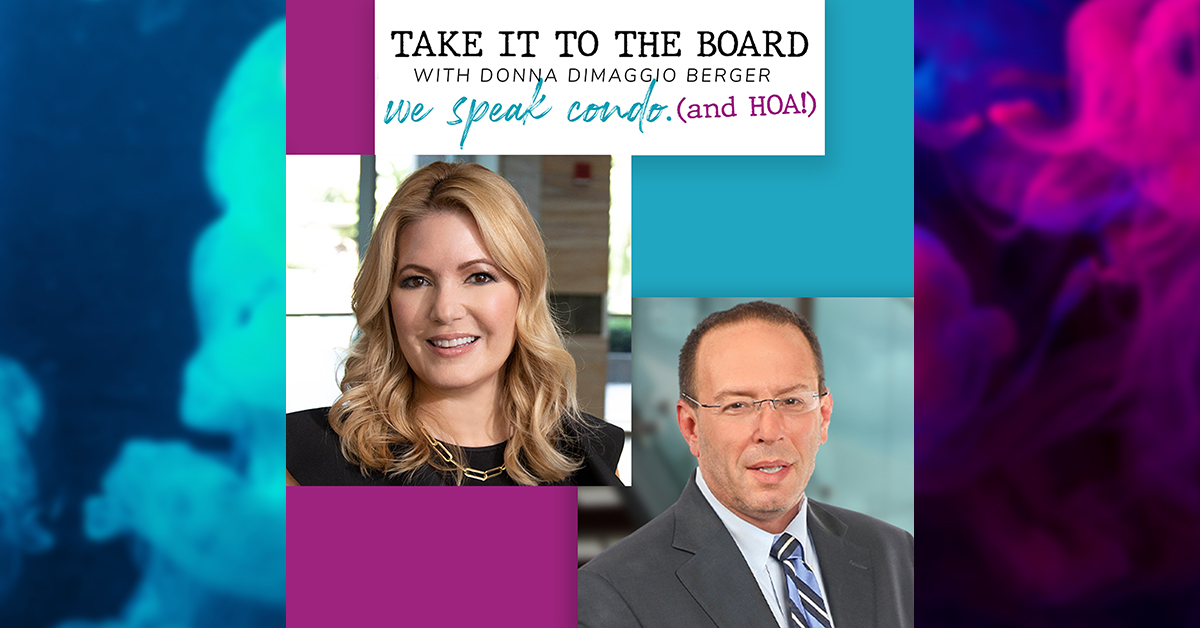
Recalls are where community politics get real. When a board receives a Recall Petition, emotions run high and so do the legal stakes. In this week’s episode of Take It To The Board, host Donna DiMaggio Berger sits down with Becker shareholder Jonathan J. Ellis, Florida Bar board-certified in condominium and planned development law, to demystify what drives recalls, how they actually work and how to steer a community through the process with as little pain as possible.
What Association Boards Should Know About Conflicts of Interest Transactions
FCAP Managers Report
By: Jonathan R. Zim
Conflicts of interest transactions remain one of the most complicated and misunderstood aspects of community association governance in Florida. While the term itself often carries a negative connotation, Florida law does not treat every conflict as improper, so long as the proper disclosures and procedures are followed. Florida Statutes Chapters 617 (Not-For-Profit Corporations Act), 718 (Condominium Act) and 720 (Homeowners Association Act), directly address conflicts of interest. Florida Statutes Chapter 719 (Cooperative Association Act) does not directly address conflicts of interest.
DID YOU KNOW?
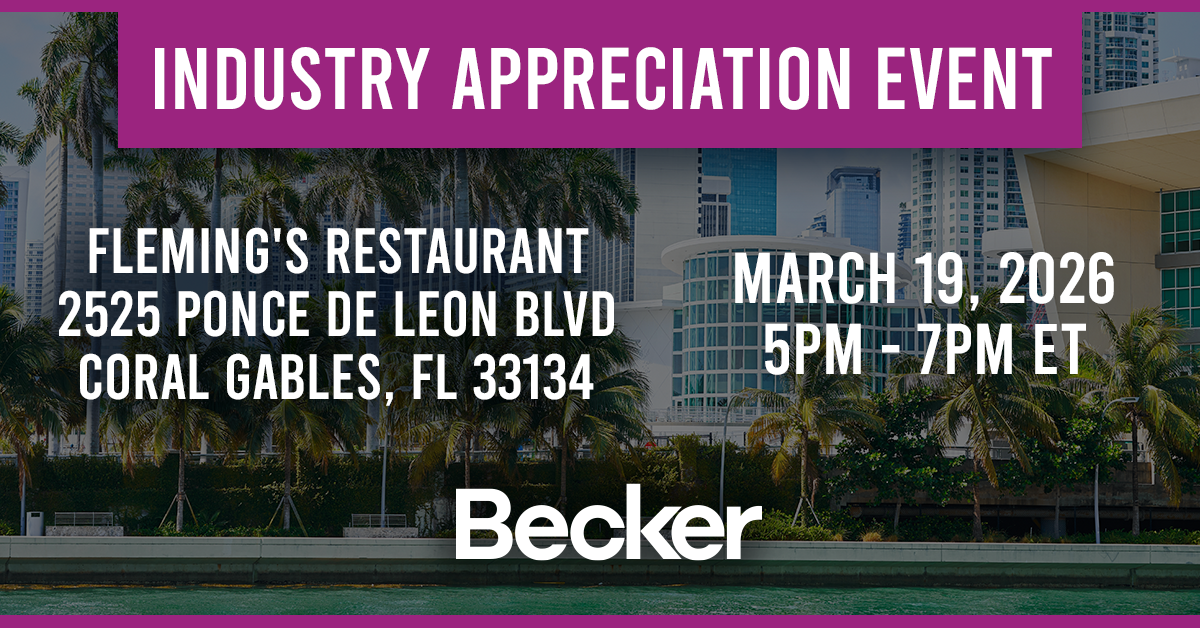
Becker is Hosting an Industry Appreciation Event on March 19 in Miami!
Please join us for an evening of refreshments, meaningful networking, and connection with Becker attorneys who serve community associations throughout Miami-Dade and across Florida. We will also present an insider’s look into proposed community association legislative changes—offering timely insight into what lies ahead and how to prepare.
This event is our way of saying thank you for the trust you place in Becker and reaffirming our ongoing commitment to the local community and the clients we proudly represent. We look forward to welcoming you and sharing an evening focused on collaboration, continuity, and the future of community association law in Florida.
If you have new members on your board or a new manager for your community and want them to be part of our Community Update, have them subscribe here:

EDITORS