
Spring is here, bringing fresh opportunities and key insights to help your community thrive. This issue of CUP will help your community association navigate special assessment funds, restrict rentals, update your governing documents, and clear up misconceptions about limited common elements. Also featured this month: how podcasting made Donna DiMaggio Berger a better lawyer. Don’t miss our exciting news, Becker expands into Pennsylvania with a new Doylestown office!
Every condominium association managing a condominium with 25 or more units, excluding timeshare units, is now required to have a website (or web portal) and a laundry list of documents are required to be posted there. Michelle H. Kaiser outlines key considerations for community associations in “Three Important Considerations if Your Condominium’s Website is Maintained by Your Management Company.”
Understanding the difference between flood and windstorm insurance is critical for Florida community associations, especially as storm risks continue to rise. Ramon C. Palacio outlines how gaps in coverage can expose associations to significant financial liability and offers practical guidance for ensuring your community is adequately protected in “Important Differences Between Flood and Windstorm Insurance. Is Your Association Adequately Protected When the Next Major Storm Hits?”
The transition from developer to owner control is a pivotal moment for any condominium association. Kaitlyn Silverberg explains why the first year after turnover is critical for protecting the building and owners’ investments, and outlines the steps boards should take to assess property conditions, preserve records, and engage the right professionals in “Our Condominium Just Turned Over From Developer Control. What’s Next?”
Whose approval a unit owner can rely on when making improvements to the common elements showcases the importance of THIS CASE. Allison L. Hertz explains that owners must obtain approvals precisely as the declaration requires, and associations should have clear, written policies for requesting approvals in “THIS CASE: Curci Village Condominium Association, Inc. v. Santa Maria.”
Articles

Every condominium association managing a condominium with 25 or more units, excluding timeshare units, is now required to have a website (which may be a web portal) or application and a laundry list of documents are required to be posted there. While there are many, here are three important considerations if your condominium association’s website (which may be a web portal) or application is maintained by your manager.

By: Ramon C. Palacio
Boards of Directors of community associations have a fiduciary duty to its members, and one of the Board’s duties is the protection of the association’s physical assets. In Florida, the need for adequate property insurance to protect against hurricanes and severe storms is inescapable. What is often misunderstood, however, are the coverage differences between protecting against the perils of flood damage and windstorm damage, even though both perils are commonly associated with hurricanes and severe storms. Failing to understand the differences between these coverages can result in costly gaps in coverage and the potential for having to levy a special assessment to address those gaps in coverage.

Our Condominium Just Turned Over From Developer Control. What’s Next?
The developer has just turned over control of the condominium association to the unit owners. There’s a new board and a long to-do list, among which is the important question: What condition is our building really in? The period immediately following turnover is one of the most critical windows in a condominium’s lifecycle. What the board does in the first six to twelve months can determine whether millions of dollars in repair costs are recovered or quietly shifted onto the owners.

Curci Village Condominium Association, Inc. v. Santa Maria
14 So.3d 1175 (Fla. 4th DCA)
By: Allison L. Hertz
Whose approval a unit owner can rely on when making improvements to the common elements showcases the importance of THIS CASE.
A unit owner made landscaping modifications to the backyard of her condominium unit, which was part of the common elements. While the developer still controlled the Association, the owner asked the president, who was the manager of the developer, if she could place decorative improvements in the backyard. The president verbally approved, saying in his opinion he “didn’t see a problem with it” if it was not permanent, did not impede the water runoff, and did not need a permit. With the president’s verbal approval, the owner installed stones and mulch in the backyard.
A few months later, the Association turned over from developer control and the unit owner-controlled Board had the Association attorney send a demand letter to the owner, stating that the modifications needed to be removed because they were causing damage and flooding to the common elements and it violated the declaration of condominium. The owner sued the Association in response, requesting that a court validate the prior president’s approval. The Association argued that the declaration required the prior written consent of the Board of Directors for improvements to the common elements and the verbal approval of the president was insufficient to comply with such requirement for written Board approval.
The trial court ruled in favor of the owner based upon the verbal approval of the president. The Association appealed. The appellate court began its opinion by noting that Florida law requires a declaration of condominium to be strictly construed. The court further stated that the declaration required owners to obtain permission of the Board prior to making improvements to the common elements, and the owner was required to comply with the declaration. The owner did not dispute that she failed to obtain written consent from the Board before she made the improvements. Instead, she argued that the Association was estopped from enforcing the restriction against her due to the president’s prior verbal approval. The appellate court began its examination of this argument by noting the elements that must be proved to establish the defense of estoppel. They briefly include: (1) a representation, (2) reliance on a representation, and (3) a change in position which is detrimental to the party who relied on the representation.
The owner’s estoppel defense here failed as a matter of law since she did not have written approval from the Board, and the verbal approval of the president could not bind the Association. The declaration was clear that written approval was required and that did not exist. The fact that approval came from the president also did not matter since the declaration that required written Board approval existed at the time the verbal approval was obtained from the president. The appellate court was clear that the owner’s reliance on the verbal approval of the president, when the requirement was for written Board approval, was not reasonable nor justified, particularly when the Association sent a demand shortly after the turnover of control of the Association to the unit owners, and reversed the trial court’s ruling in favor of the owner.
So why does THIS CASE matter? Restrictions in a declaration will be interpreted by a court to mean exactly what they say; and owners who seek approvals must do so in the way required by the declaration. Associations also need to have policies in place for owners to seek approvals, in writing, and remind board members not to provide unilateral approvals but instead advise owners to follow the established polices for seeking approval through proper channels. Reliance by any owner on an approval that is inconsistent with the declaration may be unjustified. If you believe this is an issue in your community, you should reach out to counsel to discuss the specific facts, as they are important to evaluate.
What Truly Drives Everything We Do? The Trust of Our Clients.

On March 19, Becker had the pleasure of hosting our Industry Appreciation Event at Fleming’s Prime Steakhouse in Coral Gables, bringing together the incredible clients and partners we’re privileged to serve across Miami-Dade and throughout Florida. The evening was filled with meaningful conversations, valuable insights, and the kind of connections that make our work so rewarding. More than anything, this event was about gratitude. Thank you for your continued trust, partnership, and the opportunity to support the communities you lead every day—we don’t take it for granted.
Question of the Month

Q: Last year my condominium association levied a special assessment to fund a project to remodel the building’s lobby. The project is now complete and there is a significant amount of money left over. So, questions are arising as to how the association should handle the surplus funds. What does the association need to do with this extra money?
Restricting Rentals in Condominiums and Homeowners’ Associations

FLCAJ Magazine
By: Yeline Goin
One of the questions I am frequently asked by my community association clients is whether they can restrict rentals by either (1) requiring a minimum lease term, (2) prohibiting rentals for a certain period of time after an owner purchases (for example, one year), (3) setting a maximum number of units/homes that can be rented in the community, and/or (4) requiring the owners to obtain association approval for all rentals and tenants.
Becker’s Donna DiMaggio Berger Featured in Law360: How Podcasting Made Her a Better Lawyer

Becker’s Donna DiMaggio Berger is featured in Law360’s Expert Analysis series, sharing how her podcast, Take It To The Board, has shaped her legal practice. In “Podcasting Makes Me a Better Lawyer,” Donna explains how hosting unscripted conversations with community association leaders sharpened her listening, questioning, and leadership skills—lessons she now brings to the office, boardroom, and beyond. You can read the full article here or below.
Announcing Becker’s On-Demand Class Library
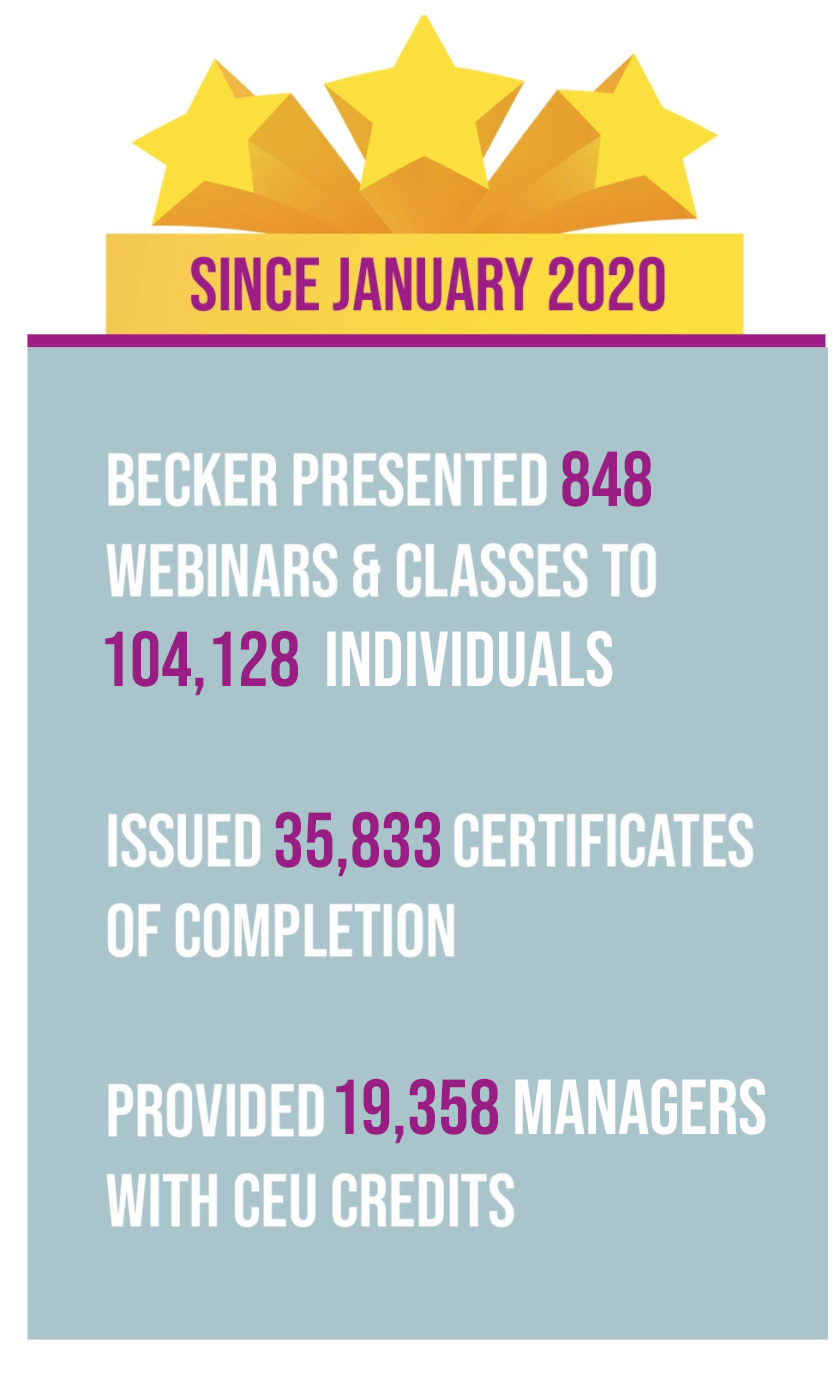
The Florida law mandates that board members of HOAs, Condominiums, and Co-ops take continuing education classes annually.*
Please see our on-demand class library for an extensive list of DBPR approved classes.

Managers and board members of non-clients are welcome to take our courses for $50, unless otherwise specified. Courses are always free for board members of firm clients.
*Breakdown of class requirements for board members and managers of HOA’s, Condominiums, and Co-ops: New Florida Educational Requirements for Board Members and Managers – Frequently Asked Questions
Frequently Asked Questions regarding Becker classes: Becker Classes FAQs


Can They Do That?

Becker’s “Can They Do That” video series tackles some of the unique problems that homeowners and renters face today. We answer your questions, no matter how far-fetched they may seem. From service animals to nudists in your community, we get to the bottom of it and let you know – “Can They Do That?”
Becker Steps Up to the Mic with Podcast,
‘Take It To The Board with Donna DiMaggio Berger’

Think you know what community association life is all about? Think again. Residents must obey the rules, directors must follow the law, and managers must keep it all running smoothly. Take It To the Board explores the reality of life in a condominium, cooperative or homeowners’ association, what’s really involved in serving on its board, and how to maintain that ever-so-delicate balance of being legally compliant and community spirited. Leading community association attorney Donna DiMaggio Berger acknowledges the balancing act without losing her sense of humor as she talks with a variety of association leaders, experts, and vendors about the challenges and benefits of the community association lifestyle. Don’t have a streaming app? You can now find all episodes on YouTube! Click here to listen now.
RECENT EPISODES:
-
- Mind Your Manners: Restoring Respect in Condo, Cooperative and HOA Communities
- Why Solar Energy Makes Sense in the Sunshine State!
- What Actually Moved the Needle for Condos & HOAs in 2025?
- How To Spot, Stop, And Report Modern Scams — with Paul Greenwood, Former Head of Elder Abuse Prosecution Unit
- From Crisis to Compliance– An Engineer’s Explanation of Milestone Inspections and SIRS in Florida Condos
- How Better Business Bureau Tools Can Help Boards Make Safer Hiring Decisions
- A Recall Roadmap — From Petition to Resolution, with Becker’s Jonathan J. Ellis
- What You Need to Know About Conspiracy Theories with University of Miami Professor Joseph E. Uscinski
- Why, When and How to Update Your Governing Documents
Why, When and How to Update Your Governing Documents

Outdated governing documents can leave associations enforcing rules written for a different era—leading to confusion, conflict, and unnecessary legal risk. In this episode of Take It To The Board, host Donna DiMaggio Berger is joined by Becker shareholder Nataly Gutierrez Vazquez, a Florida Bar board-certified specialist in condominium and planned development law, to break down what happens when documents fall behind—from obsolete developer provisions to vague standards and evolving statutes that create enforcement gray areas.
Becker Awarded FLCAJ Readers’ Choice Award for 12th Consecutive Year
For the 12th consecutive year, Becker has earned a Diamond Level Readers’ Choice Award from the Florida Community Association Journal (FLCAJ). The FLCAJ announced its annual Readers’ Choice Award winners in the March 2026 issue of the magazine. The FLCAJ Readers’ Choice Awards is a unique recognition program that shines a spotlight on the positive and productive contributions by community association service providers across Florida. These honors are bestowed on service providers who demonstrate an exemplary level of proficiency, reliability, fairness, and integrity to the community associations they serve.
Misconceptions About The Limited Common Elements

FCAP Managers Report
By: Nicolas M. Jimenez
You should always consult your legal counsel when dealing with the limited common elements of your condominium association because, chances are you hold some misconceptions about that they are or how to identify them. After all, correctly determining whether certain property is part of a unit, the common elements, or limited common elements is often essential to the proper operation of your condominium association by your board of directors and management.
DID YOU KNOW?

Becker Expands into Pennsylvania with New Doylestown Office; Experienced Community Association Attorneys Stefan Richter and Josephine Lee Wolf Join Firm
Becker is pleased to announce Stefan Richter and Josephine Lee Wolf have joined as shareholders in the Condo, Co-Op & HOA Practice to open the firm’s newest office located in Doylestown, Pennsylvania. The new Pennsylvania location highlights Becker’s growth and allows the firm to serve clients in multiple jurisdictions. The address is 2003 South Easton Road, Suite 205, Doylestown, PA 18901.
Mr. Richter focuses his practice on all aspects of community association law, including assessment collections, governing document interpretation and amendments, covenant enforcement, transition matters, and related litigation. He also has broad experience in civil litigation, including association, bankruptcy, construction, corporate, and insurance law.
Ms. Lee Wolf focuses on community and condominium association law, including assessment collections, document interpretation and amendments, covenants enforcement, transition issues and associated litigation. She has written numerous articles and has given lectures to homeowners, managers, and legal professionals on association law topics, including general legal principles of association law and governance.
Gary Rosen, Managing Shareholder and CEO said, “We extend a warm Becker welcome to Stefan and Josephine. Their Bucks County and Philadelphia area roots and extensive community association law and litigation experience will be of great value to the firm and our clients. Our presence in Pennsylvania marks an exciting new chapter for Becker, and we look forward to building on this momentum with Stefan and Josephine to further expand our Condo, Co-Op, & HOA practice in Bucks County and the greater Philadelphia metropolitan area.”


If you have new members on your board or a new manager for your community and want them to be part of our Community Update, have them subscribe here:

EDITORS